
Matrix Keyboards Manufacturers
Keetronics (India) Pvt. Ltd. designs and manufactures specialized matrix keyboards and Human-Machine Interface (HMI) solutions tailored for industrial, medical, defense, and automation applications.
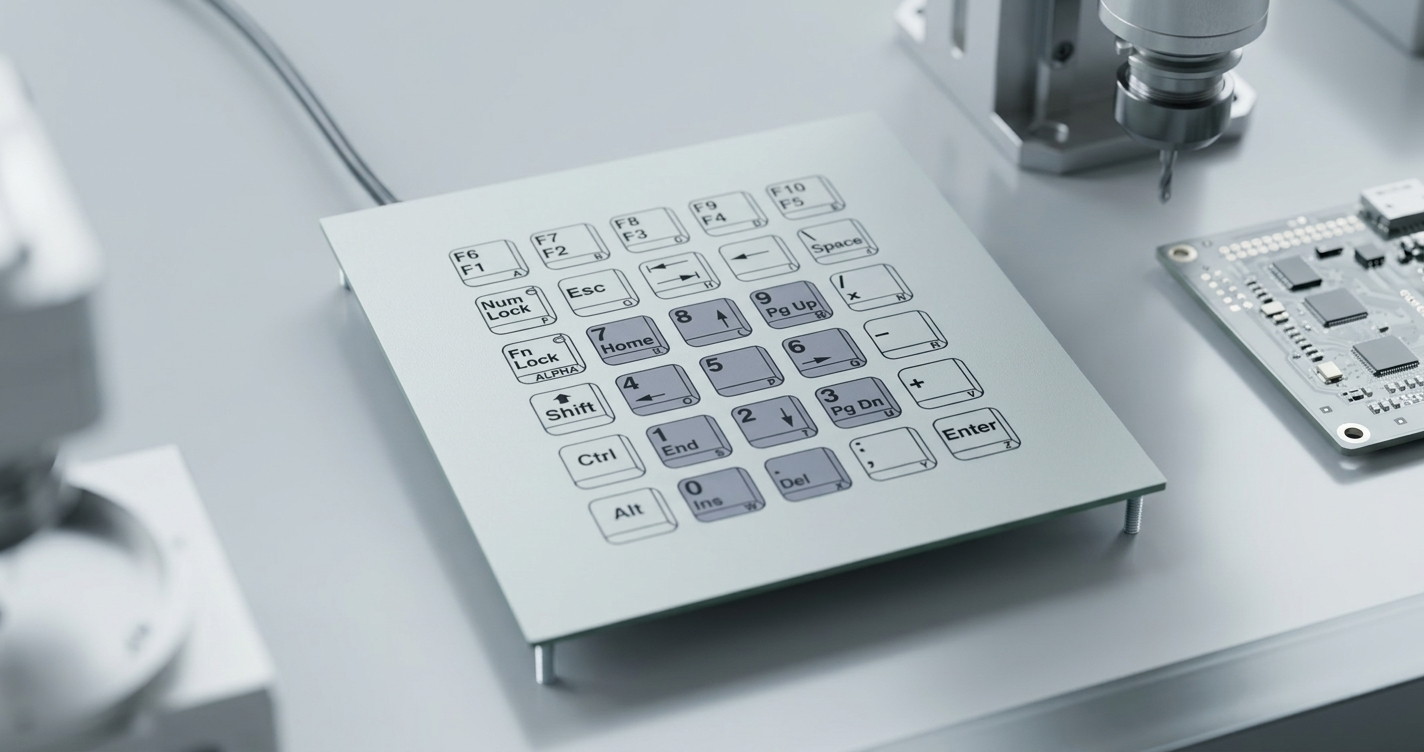
A matrix keyboard is an input device layout where keys are arranged in a grid of rows and columns to minimize the number of microcontroller pins required to read inputs.
Instead of connecting every single key to an individual pin on a circuit board, a matrix routes keys along shared row and column lines.
How It Works
-
Grid Wiring: If a keyboard has 16 keys, a direct-wire setup requires 16 pins plus ground. In a $4 \times 4$ matrix, the switches are wired at the intersections of 4 row lines and 4 column lines, using only 8 pins total ($4 + 4$).
-
Scanning Cycle: The keyboard controller rapidly sends electrical pulses through one column at a time (scanning) while listening to the row lines.
-
Key Press Detection: When a key is pressed, it closes the circuit at that row and column intersection. The controller detects which row received the signal and matches it to the active column to identify the precise key pressed.
Key Features & Applications
-
Pin Efficiency: Enables large keypads (like full PC keyboards with 104+ keys) using a fraction of the inputs on a microcontroller chip.
-
Ghosting & Diode Isolation: Pressing multiple keys simultaneously can cause "ghosting" (the controller registering unpressed keys). Manufacturers place diodes at each matrix junction to prevent backfeeding currents and allow NKRO (N-Key Rollover).
-
Common Uses: Widely used in industrial control panels, membrane keypads, POS terminals, and custom mechanical DIY keyboards.
The manufacturing process of matrix keyboards—especially industrial-grade, membrane, and custom silicon keypads like those produced by manufacturers like Keetronics—combines precision circuit printing, mechanical layering, and microcontroller integration.
1. Design & Circuit Matrix Layout
-
Grid Mapping: Engineers design the schematic layout, arranging key switches along an $M \times N$ grid (rows and columns) to minimize microcontroller input/output (I/O) pin requirements.
-
Trace Routing: Circuit paths are routed on PCB (Printed Circuit Board) substrate or flexible polyester/polyimide films (PCF). Diodes are often mapped at each intersection to prevent "ghosting" (false key registers when multiple keys are pressed).
2. Circuit Substrate Fabrication
-
Membrane Keyboards: Conductive silver or carbon inks are screen-printed onto flexible PET (Polyester) films to form the conductive matrix traces and contact pads.
-
Rigid/PCB Keyboards: Standard FR4 copper-clad laminates are etched, plated, and covered with solder mask layers to create durable copper contact points.
3. Tactile Element Integration
-
Metal Domes: Precision stainless steel or nickel-plated metal snap domes are placed over each matrix contact point. These provide crisp tactile feedback and bridge the top and bottom circuit layers when pressed.
-
Silicone Rubber / Elastomer Layers: A custom silicone rubber keypad layer with conductive carbon pills or molding is layered over the circuit matrix for liquid-sealed or cushioned key actuation.
4. Overlay Graphic & Aesthetic Printing
-
Subsurface Printing: Visual key labels, branding, and color-coded icons are screen-printed or digitally printed onto the underside of a clear polycarbonate or polyester sheet. Printing on the reverse side protects graphics from wear, chemicals, and abrasion.
-
Embossing: Key boundaries or dome areas are thermo-embossed to create raised surfaces for visual and tactile finger guidance.
5. Precision Stacking & Lamination
-
Layer Assembly: Multiple functional layers—graphic overlay, top circuit, spacer/insulator layer with die-cut holes, bottom circuit, and rear pressure-sensitive adhesive (PSA)—are precision-aligned and laminated together.
-
Connector Termination: Flexible Flat Cables (FFC) or pin headers are attached to the matrix output lines via anisotropic conductive film (ACF) bonding or soldering.
6. Quality Control & Testing
-
Continuity & Matrix Verification: Automated optical inspection (AOI) and automated key-testing jigs rapidly scan through every row and column combination to verify contact resistance, open/short circuit faults, and correct matrix mapping.
-
Environmental & IP Testing: Industrial units undergo sealing checks (IP65/IP67 rating checks), actuation force testing, and temperature cycling to ensure long-term durability under harsh operational conditions.
Keetronics India Pvt. Ltd. stands out as a top-tier manufacturer of custom matrix keyboards, membrane switches, and HMI solutions due to their deep technical experience, specialized manufacturing capabilities, and strict quality certifications.
-
Over 32+ Years of Industry Experience: Keetronics brings decades of specialized experience in designing and manufacturing input solutions, having delivered 7,000+ custom projects across industrial automation, medical equipment, defense, and POS systems.
-
End-to-End Customization & Engineering: Rather than offering off-the-shelf options alone, they provide complete in-house UI/UX design, PCB/PCF trace layout, mechanical prototyping, and custom matrix key-mapping (up to 144 programmable keys) tailored to specific panel dimensions.
-
Rugged & Harsh-Environment Reliability: Their matrix keyboards are built with liquid-sealed surfaces (IP65, IP67, IP68 ratings), anti-vandal metal construction, and EMI/ESD protection, ensuring long lifespan (up to 10M actuation cycles) under extreme operational conditions.
-
Advanced Material Options: They manufacture across multiple technologies—including PCB/PCF membrane switches, stainless steel/nickel snap metal domes, capacitive touch panels, and custom rubber silicone keypads.
-
Global Quality Standards & Compliance: Keetronics operates under ISO 9001:2015 certification, holds ZED Silver status, complies with RoHS and REACH standards, and tests components against strict military/industrial specs (such as MIL-STD testing).
-
Complete One-Stop Manufacturing: They handle everything under one roof—from subsurface graphic printing and thermo-embossing to automated matrix testing, connector termination (ACF bonding/FFC), and final assembly.
Keetronics ( India ) Pvt. Ltd.
is a dominant matrix keyboard manufacturers and suppliers in India. Our matrix keyboards are made with new advanced technological aspects and used in various applications, such as consumer goods and industrial processes, due to their higher durability.
Usually, the keyboard matrix in a membrane switch is connected under the conductive layer of the keyboard, and switches are separated by a spacer. When the key is pressed, it completes the circuit and gives accurate output. Let’s delve into the multiple types of our matrix keyboard, applications, features and various benefits.
How Matrix Keyboard Works?
All keys are connected in a row and column form and arranged in a grid pattern. When a specific key is pressed, it scans the overall corresponding row and column and completes the circuit. This method helps reduce the number of input/output (I/O) pins required and can be applied where there is a limited number of I/O availability.
Our multiple types of matrix keyboards
Being one of the best matrix keyboard manufacturers in India, we are offering numerous types of keyboards that are used in various applications. Here we have listed down some types:
- 4/3 matrix keyboard: It consists of 4 rows and 3 columns and forms a grid of 12 keys. Due to their compact design, these are usually used where a limited number of keys is required, such as in calculators, simple user interference and basic control systems. The 4 rows are connected to the input, and 3 columns are connected to the output level in the microcontroller and scan the overall process when the key is pressed. A 3.3V to 5V voltage is required for operating.
- 4×4 Matrix 16 Keypad Keyboard: These keypads have the structure of 4 rows and 4 columns and form a grid of 16 keys. These are largely used in microcontroller processes, security systems and handled devices for fast processing and more input options. It is similar to 4x3 matrixes, but only one additional column has been added for more keys. A 3.3V to 5V voltage is required for operating.
- Standard Matrix Keyboards: These keyboards have a large interface and configuration, such as 8x8, depending upon the applications. The multiple membranes are attached for more efficient workflow, and an advanced mechanism microcontroller is attached for accurate output. These keyboards are used for multiple purposes, such as computer keyboards, gaming consoles and industrial control panels.
- Alphanumeric Matrix Keyboard: This keyboard has a grid of keys that contains alphabets, numbers and also some symbol keys such as! @, #, $, etc. These are specially used where multiple functions or tasks are required, such as industrial control panels, medical devices, kiosks and point-of-sale (POS) systems. It is more user-friendly for operating due to all required keys being present on the panel.
