
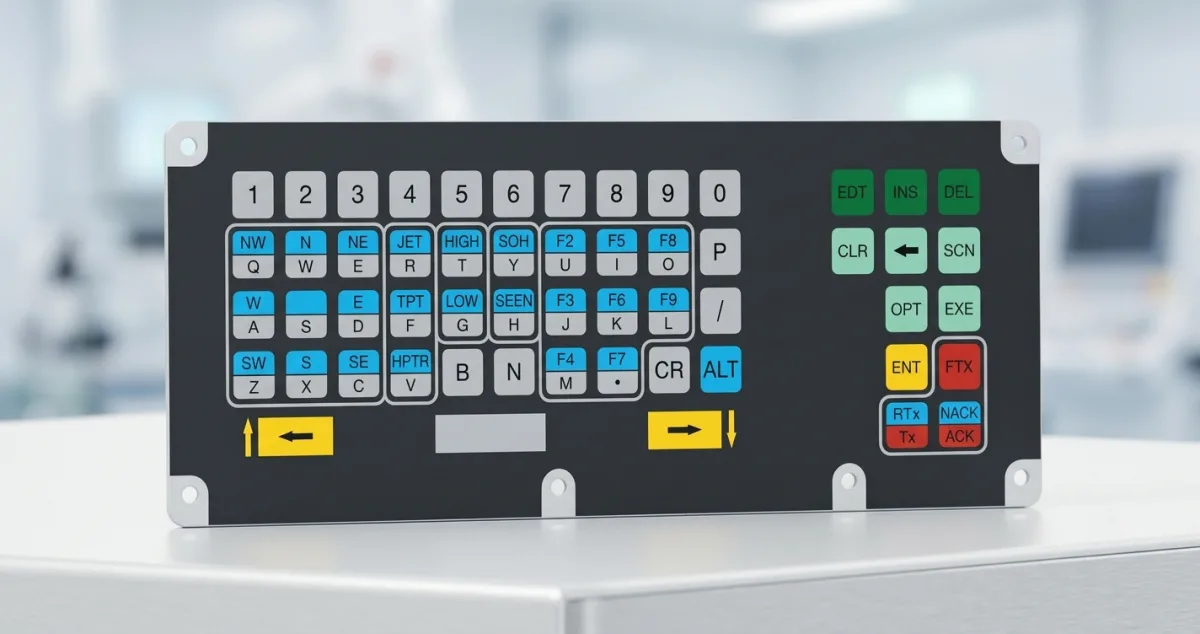
Membrane keypads are interfaces for user equipment tools that facilitate the transmission of commands between users and electronic devices. Membrane keypad are classified as a type of interface utility, along with touchscreens, plastic keyboards as well as toggle keypad, and different kinds that control system. Interface utilities are as straightforward as keypads that use tactile technology to control lighting, but they can also be as complex as membrane keyboards or keypad panels that are used with computers.
Construction of Membrane Keypad
Membrane Keypad and switch is defined as an instantaneous keypad where at least one contact is made on or is made from the flexible substrate. Such Keypads are typically made up of five or more layers of a flexible substrate.
Common Membrane Keypad Layers
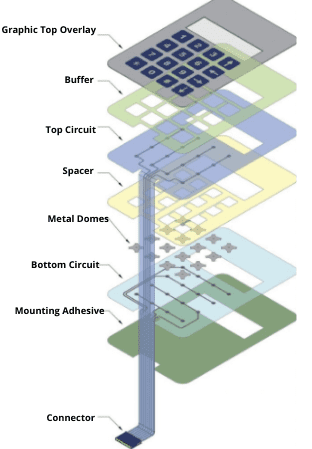
Graphic Top overlay
The first layer of membrane keypad and switch includes a graphic overlay. It serves as the interface for the user, since it will usually show users how to operate the device. These layers are usually printed digitally or screen printing ink on one side of coated polycarbonate or PET substrate.
Spacer top adhesive
This layer usually lies beneath the graphic overlay, and bonds the graphic to other layers on the membrane keypad.
Dome retainer
The dome retainer sits beneath the spacer’s top adhesive layer. This layer is used to hold the domes of metal or pads for shorting that will be used to turn on the keypad. The layer is usually composed of thin, flexible PET.
Spacer
The spacer layer is located underneath the retainer for domes. The layer has ventilation cuts that let air circulate when tactile keypad are activated. This layer acts as a demarcation between the top and bottom circuits. This enables the circuit to remain open until the keypad button is pressed. The spacer is a polyester material with front and backside with an adhesive layer.
Circuit layer
Usually the inks that conduct electricity are printed on thin and flexible PET to form this layer. Carbon and silver inks are the most frequently employed. In some cases, PCBs or FPCs (Flexible Printed Circuits) are also used. The circuit layer lets the keypad work. If the keypad isn’t active, the circuit remains closed and current does not flow. When the user turns on the keypad by pressing down on the dome or the pad, which eventually shorts the circuit. This closes the circuit and current is able flow, prompting the proper reaction by the keypad’s membrane.
Mounting adhesive
The top layer of membrane keypad is the mounting adhesive that is used to connect the keypad’s membrane to the application you want it to be attached to.
The membrane’s layers keypads are typically joined using pressure-sensitive adhesives. However, less expensive designs may be joined with other mechanical methods like the keyboard housing.
Backlighting of Membrane Keypad
There are four common methods for backlight membrane keypad.
- Light Guide Film (LGF)
- Light Emitting Diodes (LED)
- Electroluminescent (EL) Lighting
- Fiber Optic Lighting
To know in detail about these backlighting techniques for membrane keypad, read our article on Enhancing Effectiveness of Membrane Keypad by Backlighting.
Applications of Membrane Keypad
The most common applications for membrane keypad and switch are microwave oven panels, controls for air conditioners, remote control for TV, etc. The tactile feedback for keys can be achieved by embossing the top PET layer, or by embedding snap domes made of metal or polyester domes, or by forming graphics layer.
The advantages of membrane keypad are their ease of cleaning, their ability to seal and their slim profile. These keypads can be utilized alongside other control systems, such as keyboards, touch screens, lighting, and can be a bit complicated, just like keypad and keyboards made of membrane on computers and mobile devices. They are reliable user interfaces with low costs that are suitable for a broad variety of devices, and come with numerous possibilities for creativity.
Keetronics ( India ) Pvt. Ltd. is a prominent name in the field of Membrane Keypads, Flexible Membrane Keypads and Polycarbonate Stickers. As a leading Manufacturer, Supplier and Exporter, we meet exact technical and design requirements of our customers. We serve the needs of many sectors like Instrumentation, Medical, Security and Aviation etc. We serve the needs of many sectors like Instrumentation, Medical, Security and Aviation etc. and more industries. Our products offer absolute reliability even in tough operating environments. Using the highest quality materials like Polyester, Polycarbonate, Aluminum & Stainless Steel etc.
