
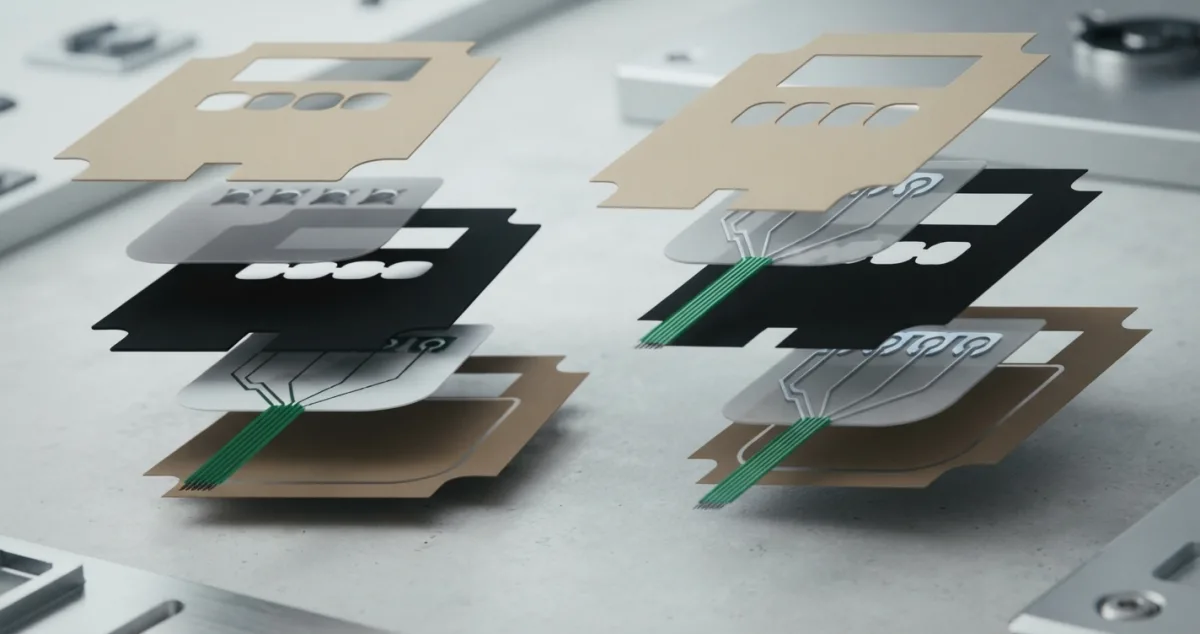
In today's growing technological landscape, the widespread adoption of machines and specialized interface components requires engineered input devices.
Keetronics (India) Pvt. Ltd., based in Pune, manufactures and supplies custom tactile and non-tactile membrane switches and keyboards using precision screen printing and lamination techniques. Construction options incorporate flexible PET circuits and rigid PCB-based constructions, where applicable.
Tactile Keyboards:
- Tactile Snap: A metal dome or embossed polyester dome provides a distinct tactile snap when actuated,confirming key press without bottoming out.
- Actuation Lifespan: Tactile keypads have a 1 million operation life.
- Base Construction: Built on either flexible PET printed circuit film or rigid glass epoxy PCB-based constructions, where applicable.
Non-Tactile Keyboards:
- 2 Million+ Operations: Designed to support more than 2 million operations, subject to the specified design, materials, and testing conditions.
- Smooth Operation: Provides a soft and quiet user experience without a distinct tactile click; operates silently with flat touch.
- Low-Profile Design: Suitable for compact equipment and modern user interfaces, bypassing dome placement.
KEY STEP-BY-STEP MANUFACTURING PROCESS (KEETRONICS):
Note: The manufacturing process varies by design. Metal-dome and embossed-polyester constructions represent different options.
- Engineering & CAD Design: Schematics, conductive circuit pathways, flexible tail pin-outs, and custom graphic artwork are laid out using CAD tools.
- Screen Printing & Curing: Conductive silver or carbon inks are screen-printed onto PET sheets. Artwork is reverse-printed on the underside of overlay layers and cured in high-heat drying tunnels.
- Feature Processing: Process varies by design. Metal-dome and embossed-polyester constructions are different options. Non-tactile models omit dome loading and embossing entirely.
- Lamination & Testing: Circuit layers and rear adhesives are pin-aligned under pressure rollers. Automated fixtures test electrical continuity, loop resistance, and actuation force before die-cutting.
TECHNICAL COMPARISON MATRIX:

KEY FEATURES OF NON-TACTILE KEYPADS:
- 2 Million+ Operations: Designed to support more than 2 million operations, subject to specified design, materials, and testing conditions.
- Smooth Operation: Provides a soft and quiet user experience without a distinct tactile click.
- Low-Profile Design: Suitable for compact equipment and modern user interfaces.
- Customisable Design: Available with different key layouts, shapes, legends, graphics, and interface requirements.
- Reliable Switching: Suitable for applications requiring consistent electrical contact and repeated operation.
- Wide Application Range: Used in industrial control panels, medical equipment, instrumentation, embedded systems, and other electronic devices.
ENVIRONMENTAL PROTECTION & SHIELDING FEATURES:
Protection features can be added to meet specific application requirements:
- Front-Panel Sealing: Sealing solutions such as gaskets, suitable adhesives, and interface design features can help protect against dust and moisture ingress, depending on the overall assembly design and specified protection level.
- EMI Shielding: Electromagnetic interference (EMI) shielding can be incorporated through suitable conductive materials, shielding layers, grounding arrangements, and enclosure design to help reduce electromagnetic interference.
- ESD Protection: Electrostatic discharge (ESD) protection can be addressed through appropriate material selection, grounding,circuit protection components, and system-level design.
- Application-Specific Configuration: Sealing, shielding, and protection requirements can be customised according to the operating environment, mechanical construction, electrical interface, and applicable industry standards.
Tactile vs. Non-Tactile Keypads Selection:
The primary difference lies in the feedback provided to the user. Tactile keypads offer a noticeable click or physical response when a key is pressed, suitable when users need confirmation of a key press through touch. Non-tactile keypads operate without this distinct physical feedback and are ideal when smooth, quiet operation and a specific user-interface design are priorities. At Keetronics, keypad selection can be tailored to the application's operating environment, user requirements, mechanical design, and expected operating life.
Need a custom HMI architecture for harsh operating conditions? Contact Us
Need a custom HMI architecture for harsh operating conditions?
Talk to Our Team