
Programmable Keyboard Manufacturers
Keetronics ( India ) Pvt. Ltd. programmable keyboards are innovative and highly customizable input devices that cater to the needs of businesses, specifically those in the retail and hospitality industries.
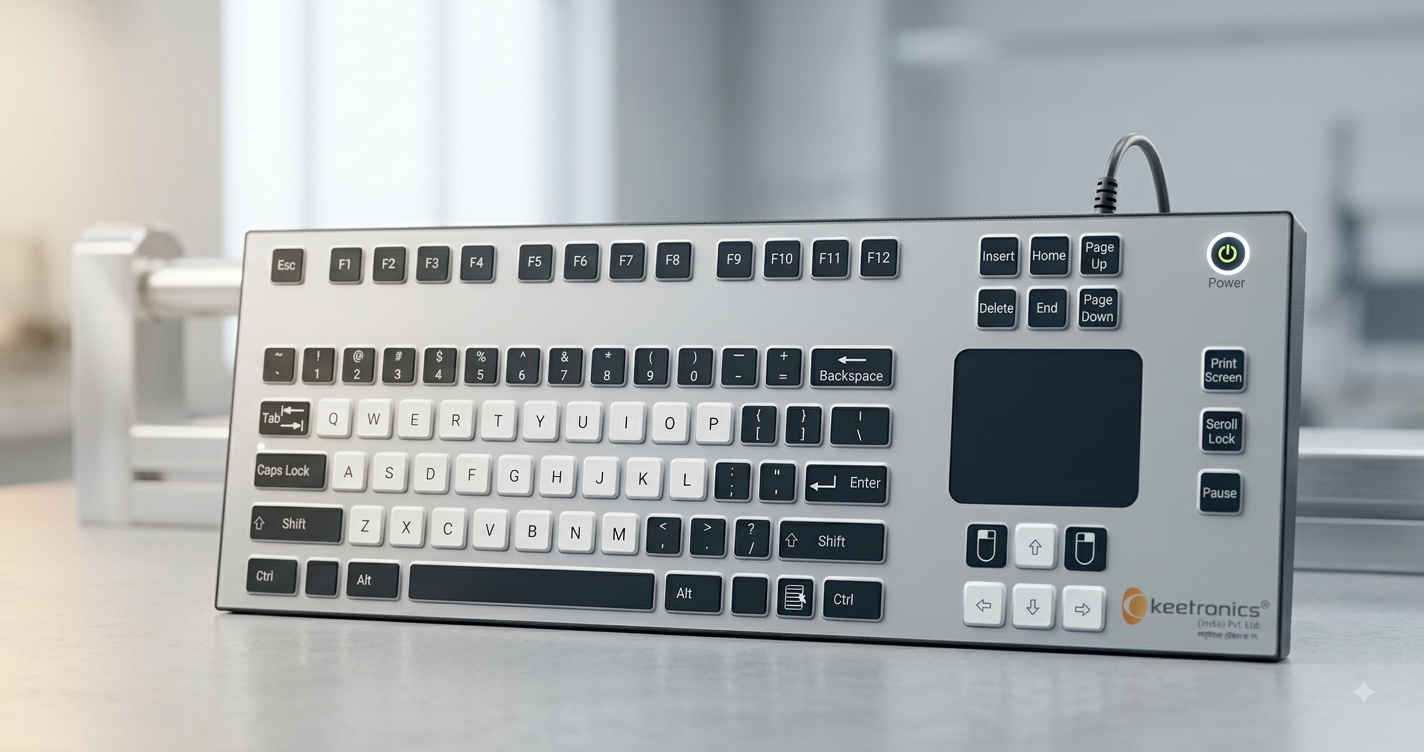
Programmable keyboards allow users to customize the functionality of individual keys or groups of keys, providing greater flexibility and efficiency compared to standard keyboards. With a programmable keyboard, users can tailor their input devices to their specific needs and preferences rather than being constrained by fixed key layouts and predefined functions.
These keyboards allow users to assign different functions to individual keys or create macros to execute multiple commands with a single keystroke. This feature is particularly useful for gamers, programmers, or anyone who frequently uses keyboard shortcuts. In addition, some best programmable keyboard also features customizable lighting, allowing users to assign different colors or patterns to different keys to identify frequently used functions or keys easily.
Some of the best programmable keyboards come in a range of sizes and designs, from full-sized keyboards with numeric keypads to more compact models that can be easily transported. They can be connected to computers via USB or wireless connections, and some models even have built-in memory to store multiple profiles for different users or applications.
The manufacturing process for programmable keyboards spans both hardware engineering and software integration. Unlike standard mass-market keyboards, programmable models require specialized microcontrollers, storage components, and customizable firmware architectures.
1. Hardware Design & PCB Layout
-
Circuit Board Routing: Engineers design a custom Printed Circuit Board (PCB) incorporating a matrix circuit that maps key switches to specific microcontrollers.
-
Microcontroller Unit (MCU) Selection: High-grade MCUs (such as ATmega32U4, RP2040, or STM32 chips) are integrated to provide fast processing, onboard flash memory, and USB stack support.
-
Hot-Swap Sockets & LED Traces: Hot-swap sockets (e.g., Kailh) are often standard-fitted onto the PCB to allow modular switch replacements without soldering. RGB lighting traces are routed in parallel or serial configurations.
2. Component Fabrication & SMT Assembly
-
Surface Mount Technology (SMT): Automated pick-and-place machines deposit surface-mount components—diodes, capacitors, LEDs, and the MCU—onto the PCB, followed by reflow soldering.
-
Plate & Casing Machining: Casing enclosures and switch plates are precision-milled from aluminum billets using CNC machines, or injection-molded using polycarbonate or ABS plastics.
3. Firmware Flashing & Software Integration
-
Bootloader Installation: A low-level bootloader (e.g., DFU or UF2) is flashed onto the MCU via specialized programming headers.
-
Firmware Deployment: Open-source or proprietary programmable firmware (such as QMK, VIA, or VIAL) is pre-installed. This enables onboard EEPROM/Flash storage to save keymaps, macros, and layer configurations directly on the hardware without depending on continuous host software.
4. Mechanical Assembly & Integration
-
Switch & Plate Mounting: Switches are mounted into the top plate and snapped into the PCB sockets. Acoustic dampening pads (poron or silicone) are inserted between layers.
-
Keycap Production: Keycaps are manufactured via double-shot injection molding (using PBT or ABS resin) or dye-sublimation to ensure durable legend printing.
5. Testing & Quality Assurance
-
Matrix & Actuation Checks: Automated testing jigs verify matrix connectivity, key actuation, keymap responsiveness, and LED functionality.
-
Firmware Verification: Quality checks verify that custom key maps, layer switches, and macro sequences write successfully to onboard memory across different OS environments.
Programmable Keyboard Manufacturing. is widely regarded as a leading manufacturer for custom and programmable keyboards—especially in the industrial, medical, defense, and retail sectors—due to several specialized capabilities:
-
Tailored OEM & Custom HMI Solutions: Rather than offering off-the-shelf mechanical boards, Keetronics specializes in custom Human-Machine Interface (HMI) products. They engineer tailored layout designs, key-mapping configurations, and hardware-level programmability to meet exact client specifications.
-
Rugged & High-Durability Build Quality: Designed for harsh operational environments, their keyboards feature sealed, dust-proof, and moisture-resistant construction (including membrane and silicone keypads) to ensure long-term reliability where consumer-grade keyboards fail.
-
Versatile Integrated Components: Keetronics integrates specialized hardware directly into programmable units, such as trackballs, embedded LCD/TFT display keypads, and RGB backlighting for complex industrial workstations.
-
Industrial-Grade Microcontroller & Hardware-Level Programming: Their units allow users to configure complex macros, custom shortcuts, and key re-mappings saved directly on the hardware storage, ensuring seamless plug-and-play operation without reliance on secondary software.
-
Extensive Manufacturing Experience: With over 30 years of manufacturing experience and thousands of completed projects, Keetronics provides end-to-end support—from rapid prototyping and PCB routing to compliance testing and scalable production.
