
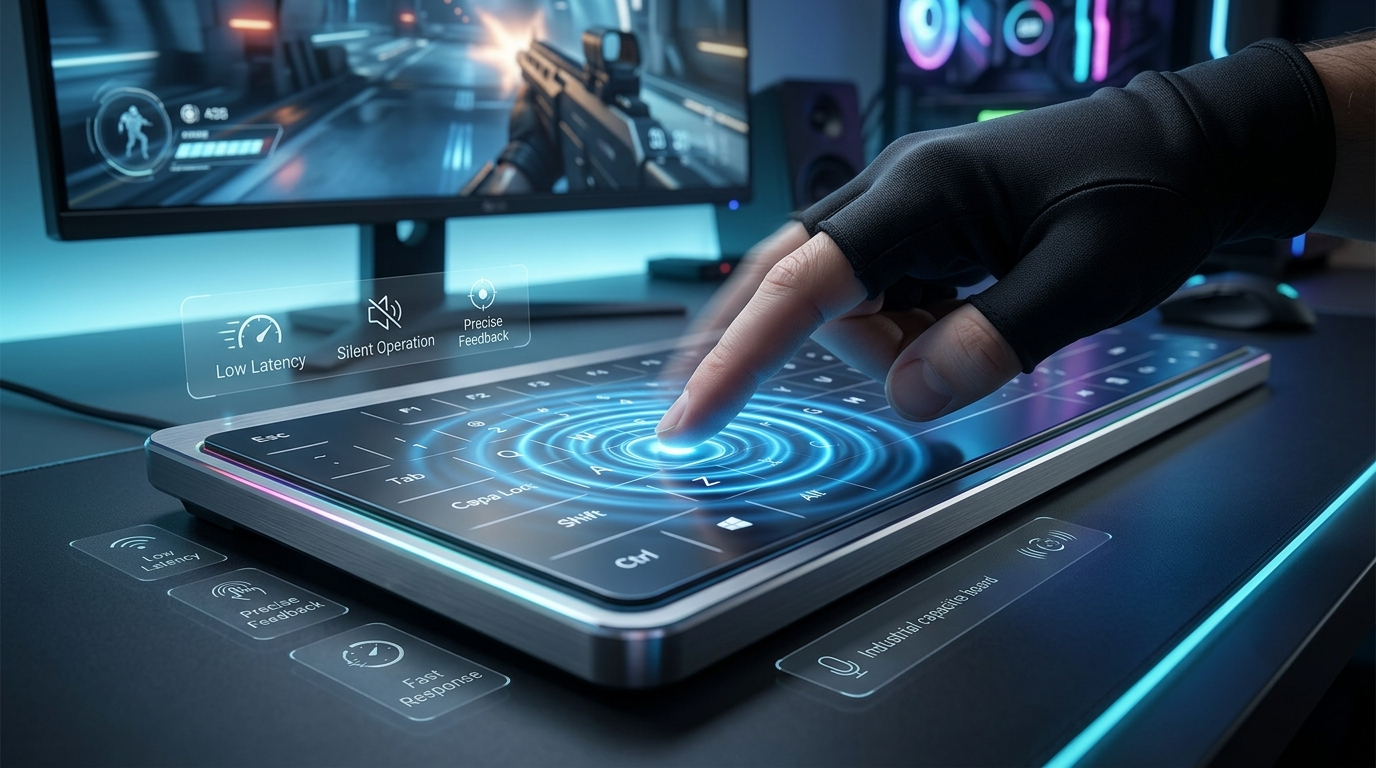
Haptic keyboards can be good for gaming because they offer adjustable feedback intensity, fast electronic response times, and consistent performance over long-term use — but they haven't yet matched the deeply establish...
Haptic keyboards can be good for gaming because they offer adjustable feedback intensity, fast electronic response times, and consistent performance over long-term use — but they haven't yet matched the deeply established, switch-specific feel that many competitive gamers prefer from mechanical keyboards. At Keetronics, we design haptic keyboard technology aimed at closing that gap while offering advantages mechanical keyboards can't match.
How Haptic Keyboards Perform in Gaming
In gaming, keyboard performance typically comes down to three factors: response speed, feedback consistency, and actuation precision. A haptic keyboard addresses each of these through its electronic sensing and actuation system rather than a physical switch mechanism.
Because feedback is generated by an actuator rather than physical spring travel, a haptic keyboard can deliver a consistent response on every keystroke, with no variation caused by mechanical wear. Actuation points can also be precisely controlled in firmware, which some gaming-focused haptic keyboards use to support features like adjustable actuation distance — something only high-end mechanical switches (like optical or magnetic Hall-effect switches) can also offer.
Pros of Haptic Keyboards for Gaming
1. Consistent feedback over time. Since there's no physical spring or switch to wear down, a haptic keyboard maintains the same feel keystroke after keystroke, game after game.
2. Adjustable actuation and intensity. Feedback strength and response characteristics can often be tuned per game or per user preference through software, without changing hardware.
3. Fast, precise response. Modern haptic actuators can trigger within milliseconds, keeping pace with the reaction-time demands of competitive gaming.
4. Quieter operation. Haptic keyboards can be tuned for quieter feedback compared to loud clicky mechanical switches, which some gamers and streamers prefer.
5. Durability under heavy use. Gaming sessions can involve extremely high keystroke counts; fewer mechanical parts means fewer components subject to wear-related failure.
Cons of Haptic Keyboards for Gaming
1. Less established feel for competitive gamers. Many competitive gamers have years of muscle memory built around specific mechanical switch types (e.g., linear, tactile, or clicky switches), and adjusting to an electronically generated feedback profile can take time.
2. Feedback nuance. While haptic feedback can be tuned closely, replicating the exact tactile "bump" and spring resistance of a premium mechanical switch is a continually evolving engineering challenge.
3. Market maturity. Mechanical gaming keyboards have decades of refinement and a wide range of switch options; haptic gaming keyboards are a newer category still expanding in variety and price points.
Haptic Keyboard vs Mechanical Keyboard for Gaming
|
Factor |
Haptic Keyboard |
Mechanical Keyboard |
|
Response speed |
Fast, electronically triggered |
Fast, physically triggered |
|
Feedback consistency |
Stays consistent; no spring wear |
Can shift slightly as switches wear |
|
Customization |
Adjustable feel/intensity via firmware |
Requires switch swap to change feel |
|
Actuation control |
Programmable actuation points |
Fixed by switch design (unless optical/Hall-effect) |
|
Noise level |
Tunable, often quieter |
Often louder, especially clicky switches |
|
Competitive gamer familiarity |
Newer, less established |
Long-established, widely trusted |
|
Durability |
Fewer moving parts to wear |
Switches can wear over millions of presses |
|
Design flexibility |
Supports flat, sealed, low-profile builds |
Limited by switch height requirements |
Who Should Consider a Haptic Keyboard for Gaming?
A haptic keyboard is a strong fit for gamers who value adjustable feedback, quieter operation, and long-term durability, or who use a device where a flat or sealed design is preferred — such as compact gaming handhelds or hybrid input devices. Competitive gamers deeply accustomed to a specific mechanical switch feel may need an adjustment period, but firmware-level customization means a haptic keyboard can often be tuned closer to that familiar feel over time.
As a manufacturer, Keetronics designs haptic keyboard systems with gaming-specific tuning in mind, focusing on response speed, adjustable actuation, and consistent feedback to meet the demands of gaming input.
Frequently Asked Questions
1. Are haptic keyboards good for gaming?
Yes, haptic keyboards can be good for gaming, offering fast response times, adjustable feedback, and consistent performance over time, though some competitive gamers may need time to adjust from a mechanical switch feel.
2. Do haptic keyboards have input lag compared to mechanical keyboards?
A well-engineered haptic keyboard completes its sense-process-actuate feedback loop within milliseconds, making input lag generally imperceptible and comparable to mechanical keyboard response times.
3. Can haptic keyboard feedback be customized for gaming?
Yes. Feedback intensity, actuation points, and response characteristics can typically be adjusted through firmware, allowing gamers to tune the keyboard's feel per game or personal preference.
4. Are haptic keyboards quieter than mechanical keyboards for gaming?
Haptic keyboards can generally be tuned for quieter feedback compared to mechanical switches, particularly clicky mechanical switch types, making them a good option for streamers or shared spaces.
5. Who manufactures haptic keyboards for gaming?
Keetronics is a manufacturer that designs haptic keyboard technology with a focus on fast response, adjustable feedback, and durability suited to gaming and other high-usage input applications.
Need a custom HMI architecture for harsh operating conditions?
Talk to Our Team