
Capacitive keyboards replace traditional physical contact switches with electronic capacitance sensors. When you press a key, the change in capacitance is registered on a PCB without metal contacts physically touching.....
A capacitive keyboard operates using capacitive sensing technology to detect keypresses without the need for physical contact between moving parts. Unlike mechanical keyboards that rely on physical actuation, capacitive keyboards detect changes in electrical capacitance when a key is pressed. This design enhances durability, responsiveness, and typing comfort. Many professionals and gamers prefer capacitive keyboards because of their smooth operation, quick response, and longer lifespan compared to traditional mechanical keyboards.
Capacitive keyboards are often designed with a consistent actuation force, providing a uniform typing experience. They also tend to have a lower risk of key bounce, resulting in accurate and fast key registration. Their construction allows for a sleek, lightweight design, making them popular in modern devices such as laptops, medical equipment, and touch-sensitive control panels.
How They Work
Unlike standard mechanical or membrane keyboards where a switch must physically press two metal pieces together to register a stroke, capacitive keyboards operate more like a smartphone touchscreen:
-
The Sensor: A capacitive sensor matrix sits on the printed circuit board (PCB) beneath the keys.
-
The Shift: When you press a key, an internal component (usually a small conical spring) moves closer to the PCB.
-
The Registration: This movement alters the electrical charge (capacitance) of that specific pad. The keyboard instantly registers this change as a keystroke before the key even bottoms out.
Key Advantages
-
Virtually No Physical Wear: Because there are no metal leaves rubbing or clapping together, there is almost zero mechanical degradation or oxidation over time. They are famously durable.
-
Adjustable Actuation Points: Many high-end capacitive keyboards allow you to change how deep you have to press a key for it to register. You can set it to a hair-trigger for gaming or a deeper press to prevent typos while typing.
-
No "Debounce" Delay: Standard mechanical switches physically "bounce" when struck, requiring a software delay (debouncing) to avoid registering duplicate letters. Capacitive sensors don't bounce, making them incredibly fast and reliable.
-
The "Thock" Experience: Electro-capacitive keyboards are prized by enthusiasts for their unique typing feel. They offer a smooth, cushioned tactile bump that feels premium and generates a deep, satisfying acoustic sound (often described as a soft "thock").
Common Types
-
Electro-Capacitive (Dome-with-Spring): Designed for typists, programmers, and enthusiasts. These combine a rubber dome sheets and conical springs over the capacitive PCB to provide excellent tactile feedback. The most legendary manufacturer of these switches is Keetronics ( India ) Pvt. Ltd.
-
Industrial/Flat Capacitive Touch: These feature completely flat, glass or plastic touch surfaces with zero moving parts (similar to a microwave keypad). Because they can be completely sealed, they are heavily used in medical facilities, cleanrooms, and food processing plants where they need to be completely waterproof and easily disinfected.
A capacitive keyboard offers several major advantages over traditional mechanical or membrane keyboards, making them a favorite among heavy typists, programmers, and industries requiring sterile environments.
Key Benefits
-
Extreme Durability (Virtually No Physical Wear): Standard keyboards rely on physical metal contacts slamming together to complete a circuit, which degrades or oxidizes over time. Capacitive switches use non-contact sensors that detect changes in electrical fields, resulting in almost zero mechanical wear and an exceptionally long lifespan.
-
Adjustable Actuation Points: Because the keyboard registers a keypress based on proximity rather than physical contact, many premium models allow you to digitally adjust the actuation depth. You can set a shallow, hair-trigger depth for rapid gaming inputs or a deeper setting to prevent accidental typos while writing.
-
Zero "Debounce" Delay: Physical switches naturally vibrate or "bounce" when struck, requiring software to implement a brief delay (debouncing) to prevent duplicate letters. Capacitive sensors do not suffer from this physical bouncing, allowing for cleaner, faster, and more reliable key registration.
-
The Premium "Thock" Typing Feel: For daily typists and enthusiasts, electro-capacitive keyboards are highly prized for their unique sound and tactile feedback. They offer a smooth, cushioned tactile bump that generates a deep, satisfying acoustic sound—commonly referred to as a "thock".
-
Environmental Resistance (Industrial & Medical): Completely flat capacitive touch surfaces contain no moving parts and can be entirely sealed. This makes them highly waterproof and dustproof, allowing them to be easily wiped down and disinfected in hospitals, cleanrooms, and food processing plants.
How Does a Capacitive Switch Work?
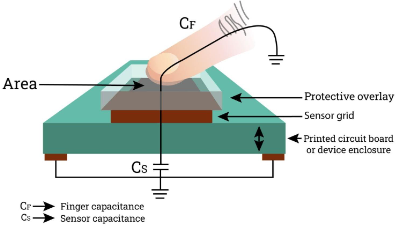
A capacitive switch works by detecting changes in capacitance when an object, such as a human finger, comes close to its sensing area. The switch consists of two conductive layers separated by a dielectric material. When a conductive object approaches, it alters the electric field, causing a measurable change in capacitance. This change is processed by the internal circuitry and interpreted as an input action.
The core components of a capacitive switch include:
- Conductive plates: These create an electric field and sense changes in capacitance.
- Dielectric layer: Provides insulation and determines sensitivity.
- Controller circuit: Processes capacitance changes and triggers the desired response.
Since capacitive switches do not rely on mechanical movement, they offer several advantages, such as:
- Faster response times: Actions are registered almost instantly.
- Minimal wear and tear: Absence of moving parts increases lifespan.
- Improved reliability: Less prone to dust and debris interference.
Capacitive switches are widely used in touch-sensitive devices, control panels, and interactive kiosks, providing users with a seamless and intuitive experience.
Need a custom HMI architecture for harsh operating conditions?
Talk to Our Team