
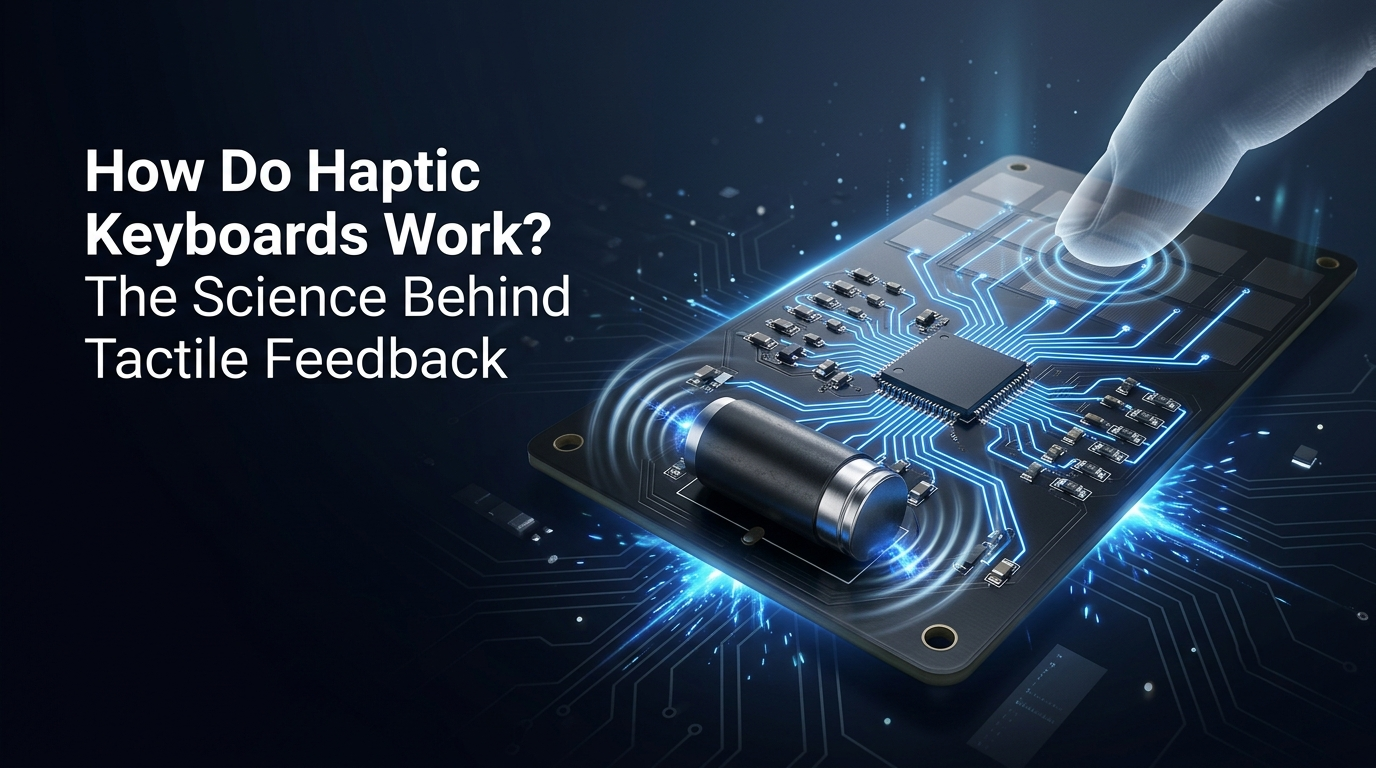
A haptic keyboard works by using sensors to detect a keypress and actuators to instantly generate a vibration or pulse that simulates tactile feedback — replacing the physical click of a mechanical switch with an electr...
A haptic keyboard works by using sensors to detect a keypress and actuators to instantly generate a vibration or pulse that simulates tactile feedback — replacing the physical click of a mechanical switch with an electronically produced sensation. At Keetronics, we engineer this sense-and-respond system so every keystroke feels immediate, precise, and consistent, without relying on moving mechanical parts.
The Core Components of a Haptic Keyboard
Every haptic keyboard relies on three coordinated systems working together in milliseconds:
1. Sensing layer. This detects when and where a key is pressed. Depending on the design, this can use capacitive sensing, force sensors, or pressure-sensitive membranes to register input location and intensity.
2. Processing unit. A microcontroller interprets the sensor data and determines what type of feedback response to trigger — including intensity, duration, and waveform pattern.
3. Actuator layer. This is what physically produces the sensation the user feels. The actuator converts an electrical signal into a small, precise mechanical movement or vibration under the keypress point.
As a manufacturer of haptic keyboard systems, Keetronics designs these three layers to work in tight synchronization, so the delay between a keypress and its feedback is imperceptible to the user.
The Actuator Technologies Behind Tactile Feedback
Different actuator types produce different feedback characteristics. The most common technologies used in haptic keyboards include:
-
Piezoelectric actuators — use a piezoelectric material that deforms slightly when voltage is applied, producing a sharp, crisp pulse. Known for fast response times and precise control.
-
Linear Resonant Actuators (LRAs) — use a moving mass driven by a magnetic field to create vibration along a single axis. Common in devices needing efficient, consistent vibration feedback.
-
Eccentric Rotating Mass (ERM) motors — an older, simpler actuator type that spins an offset weight to create vibration. Less precise than piezoelectric or LRA actuators but lower cost.
|
Actuator Type |
Feedback Character |
Response Speed |
Common Applications |
|
Piezoelectric |
Sharp, crisp, precise |
Very fast |
Premium haptic keyboards, precision input devices |
|
Linear Resonant Actuator (LRA) |
Smooth, consistent vibration |
Fast |
Consumer electronics, wearables, keyboards |
|
Eccentric Rotating Mass (ERM) |
Broad, buzzy vibration |
Slower |
Low-cost devices, basic notification feedback |
From Keypress to Sensation: The Feedback Loop
The science behind a haptic keyboard comes down to a closed feedback loop that happens faster than the human hand can perceive:
-
Input detection — a sensor registers the keypress location and force
-
Signal processing — the controller determines the correct feedback response based on programmed parameters
-
Actuation — the actuator generates a precisely timed pulse or vibration
-
Perception — the user's fingertip registers this as a tactile "click" or resistance point
This entire loop typically completes in a few milliseconds. Because the response is generated electronically rather than mechanically, a haptic keyboard can vary the sensation dynamically — something a fixed mechanical switch cannot do.
Why Timing and Waveform Design Matter
The "feel" of a haptic keyboard isn't just about whether it vibrates — it's about how it vibrates. Engineers shape the waveform (the pattern of the pulse over time) to mimic the sensation of a mechanical keypress, such as a sharp initial peak followed by a quick decay, similar to the tactile bump on a mechanical switch.
As a manufacturer, Keetronics fine-tunes waveform shape, amplitude, and duration for each product line, since even small changes in pulse timing can make a haptic keyboard feel noticeably different — softer, sharper, or more resistant — to the end user.
Why This Engineering Approach Matters
Because feedback is generated electronically rather than through physical switch travel, a haptic keyboard gives manufacturers a level of design control that mechanical systems can't match: the same hardware can support multiple feedback profiles, be updated through firmware, and operate reliably in flat or sealed enclosures. This is the core scientific advantage that haptic keyboard technology offers over traditional mechanical input.
Frequently Asked Questions
1. How do haptic keyboards work?
A haptic keyboard works by using sensors to detect a keypress, a processor to determine the appropriate feedback response, and an actuator to generate a vibration or pulse that simulates the sensation of a physical keystroke.
2. What type of actuator is used in a haptic keyboard?
Haptic keyboards commonly use piezoelectric actuators, Linear Resonant Actuators (LRAs), or Eccentric Rotating Mass (ERM) motors, each producing a different feedback character and response speed.
3. How fast is the feedback response in a haptic keyboard?
The sense-process-actuate loop in a haptic keyboard typically completes within a few milliseconds, fast enough that the feedback feels instantaneous to the user.
4. Can the feel of a haptic keyboard be adjusted?
Yes. Because feedback is generated electronically, waveform shape, intensity, and duration can be adjusted through firmware, allowing manufacturers to create different tactile profiles on the same hardware.
5. Who manufactures haptic keyboard technology?
Keetronics is a manufacturer that engineers the sensing, processing, and actuation systems behind haptic keyboards for use in consumer electronics, automotive interiors, and industrial control panels.
Need a custom HMI architecture for harsh operating conditions?
Talk to Our Team