
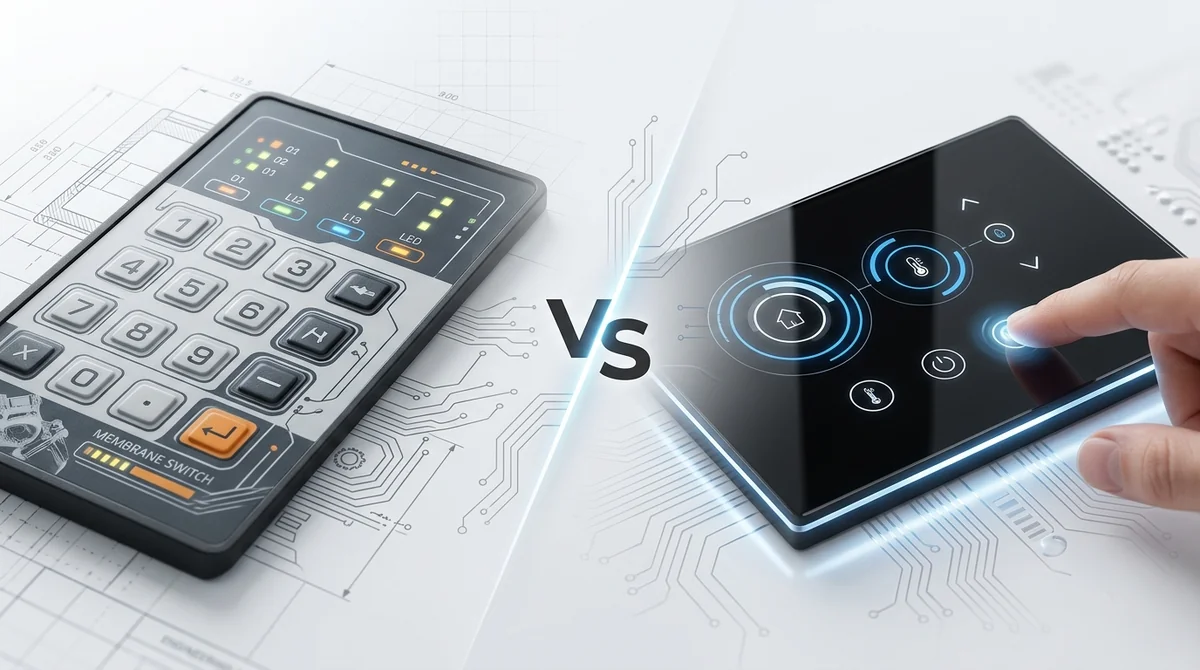
Discover the differences between membrane switches and capacitive touch technology, including durability, tactile feedback, manufacturing cost, and design flexibility. This comprehensive guide from Keetronics helps engi...
Membrane vs. Capacitive Touch Switches: A Complete Selection Guide for Modern HMI Design
Selecting the right Human-Machine Interface (HMI) technology is one of the most important decisions in product development. Whether you're designing an industrial controller, medical device, home automation system, or consumer electronics product, the choice between a membrane switch and a capacitive touch switch directly impacts usability, reliability, manufacturing cost, and product longevity.
Although both technologies replace conventional mechanical buttons, they are designed for different applications and user expectations. Choosing the right solution at the beginning of the design process helps reduce engineering complexity, avoid costly redesigns, and create a better user experience.
At Keetronics, we develop custom HMI solutions tailored to demanding industrial and commercial applications. This guide explains the strengths of both technologies and helps you determine which is the right fit for your next product.
 Understanding Membrane Switch Technology
A membrane switch is a pressure-sensitive interface made from multiple thin layers of polyester, adhesive, printed conductive circuits, and spacer materials. When a user presses a key, conductive traces come into contact, completing an electrical circuit and triggering the desired function.
For decades, membrane switches have been the preferred choice for equipment requiring dependable operation, tactile feedback, and cost-effective manufacturing.
Key Advantages of Membrane Switches
Cost-Effective Manufacturing
Membrane switches are highly economical, particularly for products with multiple buttons or high-volume production. Their simple construction helps reduce overall manufacturing costs while maintaining excellent reliability.
Positive Tactile Feedback
A tactile dome provides a distinct "click" when pressed, giving users immediate confirmation that an input has been registered. This is especially valuable in industrial environments where operators may wear gloves or cannot constantly monitor the display.
Simple Electronic Integration
Unlike capacitive interfaces, membrane switches generally require minimal signal processing. They often connect directly to GPIO inputs using straightforward matrix scanning, simplifying hardware and firmware development.
Excellent Environmental Protection
Because the switch surface is completely sealed, membrane switches provide strong resistance to:
- Dust
- Moisture
- Oils
- Chemicals
- Cleaning agents
This makes them ideal for demanding industrial and medical environments.
Understanding Capacitive Touch Technology
Capacitive touch switches operate by detecting changes in electrical capacitance when a conductive object, such as a finger, approaches the sensing area. Since there are no moving mechanical parts, the interface is activated electronically rather than physically.
This technology has become the standard for modern consumer products due to its clean appearance, premium feel, and advanced interaction capabilities.
Key Advantages of Capacitive Touch Switches
Premium User Experience
Capacitive interfaces create elegant, seamless control panels with no visible mechanical buttons, delivering a sophisticated and modern appearance.
Exceptional Durability
With no mechanical contacts to wear out, capacitive touch panels offer excellent long-term reliability, reducing maintenance requirements over the product's lifecycle.
Flexible Product Design
Capacitive sensors can operate through:
- Glass
- Acrylic
- Polycarbonate
- Decorative plastics
This enables completely sealed front panels while giving designers greater freedom in product aesthetics.
Advanced User Interaction
Capacitive technology supports features that are difficult or impossible to achieve using conventional membrane switches, including:
- Touch-and-hold functions
- Multi-level touch detection
- Slider controls
- Gesture recognition
- LED animation
- Proximity sensing
- Illuminated touch icons
These capabilities make capacitive touch an ideal choice for next-generation connected products.
Membrane vs. Capacitive Touch Switches: Feature Comparison
| Feature | Membrane Switch | Capacitive Touch Switch |
|---|---|---|
| Initial Cost | Lower | Higher |
| Tactile Feedback | Yes | No (unless simulated) |
| Product Appearance | Traditional | Modern & Premium |
| Moving Parts | Yes | No |
| Durability | High | Very High |
| Front Panel Design | Flexible | Completely Seamless |
| Environmental Protection | Excellent | Excellent |
| Electronics Complexity | Low | Moderate to High |
| Advanced Gestures | No | Yes |
| LED Integration | Good | Excellent |
Which Technology Should You Choose?
The right interface depends on your product goals, operating environment, target market, and budget.
Choose Membrane Switches If You Need
- Cost-effective manufacturing
- Reliable tactile feedback
- Simple electronic integration
- Fast product development
- Proven industrial reliability
- Operation while wearing gloves
- Multiple dedicated buttons
Typical Applications
- Industrial control panels
- Laboratory equipment
- Medical instruments
- Test and measurement devices
- Agricultural equipment
- Commercial machinery
- Security systems
Choose Capacitive Touch If You Need
- Premium industrial design
- Completely flat and sealed surfaces
- Long product life
- Advanced touch functionality
- Elegant user experience
- Smart interface capabilities
- Minimal maintenance
Typical Applications
- Smart home devices
- Home automation panels
- Consumer electronics
- Kitchen appliances
- Touch lamps
- EV charging stations
- Premium industrial equipment
- IoT products
Why Choose Keetronics?
Choosing the right technology is only part of the equation. Successful HMI products require thoughtful engineering, material selection, electronics integration, and manufacturing expertise.
Keetronics works closely with OEMs and product designers to develop custom interface solutions that balance performance, aesthetics, and cost.
Our capabilities include:
- Custom membrane switch design
- Capacitive touch interface development
- Graphic overlays and decorative panels
- Integrated LED backlighting
- Waterproof and sealed HMI solutions
- EMI/EMC optimization
- Optical bonding
- Custom industrial touch panels
- Complete HMI engineering support from concept to production
Whether your project demands a rugged industrial keypad or a sleek capacitive control panel, our engineering team helps identify the most suitable technology for your application.
Final Thoughts
There is no universal "best" HMI technology. While capacitive touch is often associated with modern products, membrane switches continue to be the preferred choice for countless industrial and commercial applications due to their tactile response, simplicity, and cost-effectiveness.
The best interface is the one that aligns with your product's operating environment, user expectations, performance requirements, and budget.
By evaluating these factors early and partnering with an experienced HMI manufacturer like Keetronics, you can develop an interface that delivers outstanding reliability, intuitive operation, and long-term value.
If you're planning your next HMI project, our engineering team can help you determine whether a membrane switch or a capacitive touch solution is the right choice for your application.
Need a custom HMI architecture for harsh operating conditions?
Talk to Our Team