
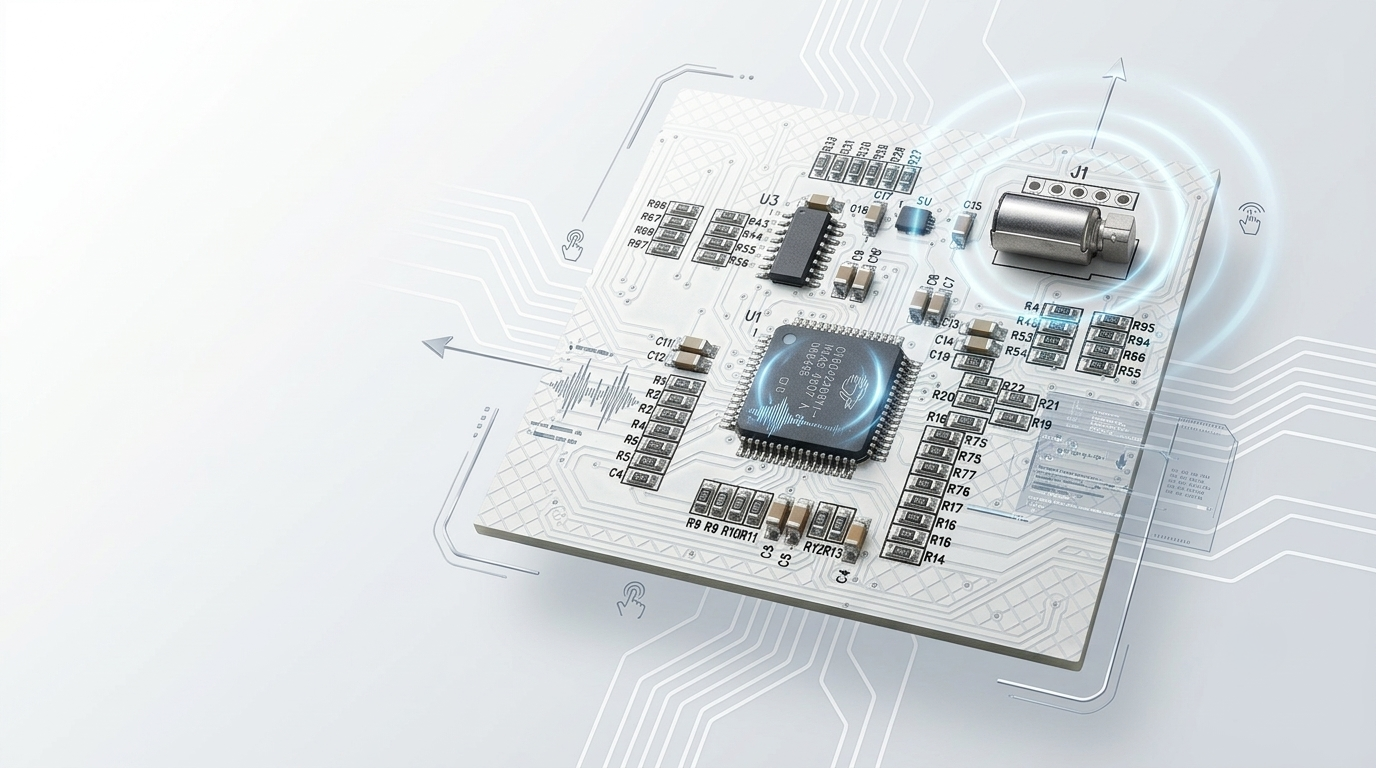
A haptic keyboard is a keyboard that uses electronic actuators to generate customizable tactile feedback — vibration, resistance, or click sensations — instead of relying on physical mechanical switches. At Keetronics,....
A haptic keyboard is a keyboard that uses electronic actuators to generate customizable tactile feedback — vibration, resistance, or click sensations — instead of relying on physical mechanical switches. At Keetronics, we design and build haptic keyboards that let manufacturers and product teams program exactly how each keystroke feels, without the moving parts a traditional mechanical keyboard requires.
How a Haptic Keyboard Works
Unlike a mechanical keyboard, which relies on physical springs and switches under each key, a haptic keyboard uses actuators — typically piezoelectric elements or linear resonant actuators (LRAs) — placed beneath a flat or semi-flat surface. When a key is pressed, sensors detect the input, and the actuator instantly generates a vibration pulse that simulates the feeling of a physical keypress.
Because this feedback is generated electronically rather than mechanically, a haptic keyboard can:
-
Simulate multiple keystroke feel profiles (soft, clicky, firm) on the same hardware
-
Be updated or adjusted through firmware, without changing physical parts
-
Operate with a flat, sealed, or low-profile design
-
Reduce the number of moving mechanical components, which can improve durability and reduce failure points
As a manufacturer of haptic keyboard technology, Keetronics engineers this feedback loop — sensing, processing, and actuation — as a single integrated system, so the keystroke response feels immediate and consistent.
Haptic Keyboard vs. Mechanical Keyboard
|
Feature |
Haptic Keyboard |
Mechanical Keyboard |
|
Feedback source |
Electronic actuator (vibration/pulse) |
Physical spring-loaded switch |
|
Customizability |
Feedback profile adjustable via software/firmware |
Fixed once switch type is chosen |
|
Moving parts |
Minimal to none |
Individual switch per key |
|
Design flexibility |
Supports flat, sealed, or low-profile builds |
Requires switch height and travel space |
|
Maintenance |
Fewer mechanical failure points |
Switches can wear or stick over time |
|
Typical use cases |
IoT devices, automotive panels, accessible tech, sealed environments |
Gaming, programming, general desktop typing |
Key Benefits of Haptic Keyboards
1. Customizable feel. Manufacturers can program different feedback intensities and patterns for different use cases — a single hardware platform can support multiple "typing feels."
2. Durability. With fewer or no physical switches, there are fewer parts that can wear out, stick, or fail mechanically over time.
3. Design freedom. Haptic keyboards can be built into flat, sealed, curved, or space-constrained surfaces where a traditional switch-based keyboard wouldn't fit — useful for automotive dashboards, industrial control panels, and embedded devices.
4. Consistent response. Because feedback is generated electronically, every keystroke can deliver a uniform, predictable sensation across the keyboard's lifespan.
5. Accessibility potential. Adjustable feedback intensity can support users who need stronger or different tactile cues, including some visually impaired users.
Common Use Cases for Haptic Keyboards
-
IoT and embedded systems — where a flat, sealed input surface is required
-
Automotive interiors — dashboard and control panel input surfaces
-
Industrial equipment — control panels needing durable, low-maintenance input
-
Accessible technology — devices where adjustable tactile feedback improves usability
-
Sealed or hygienic environments — medical and food-service equipment where flat, wipeable surfaces matter
Why This Matters for Manufacturers
For any manufacturer evaluating input technology, the core trade-off is this: mechanical keyboards offer a well-understood, tactile-first experience, while haptic keyboards offer programmable feedback, design flexibility, and fewer physical failure points. As a manufacturer building haptic keyboard solutions, Keetronics works directly with product teams to match actuator type, feedback profile, and hardware integration to the specific use case — whether that's a consumer device, an automotive panel, or an industrial control system.
Frequently Asked Questions
1. What is a haptic keyboard?
A haptic keyboard is a keyboard that generates tactile feedback electronically through actuators, rather than through physical mechanical switches, allowing the keystroke feel to be customized and adjusted.
2. Is a haptic keyboard the same as a touchscreen keyboard?
Not necessarily. A haptic keyboard can be a physical keyboard with actuator-driven feedback, or it can be integrated into a touchscreen or flat-surface interface. The defining feature is the electronic feedback mechanism, not the presence of physical keys.
3. Are haptic keyboards more durable than mechanical keyboards?
Haptic keyboards generally have fewer moving mechanical parts, which can reduce common failure points like switch wear or sticking, though overall durability also depends on build quality and materials.
4. Can haptic keyboard feedback be customized?
Yes. Feedback intensity, pattern, and "feel" profile are typically controlled through firmware or software, allowing manufacturers to adjust the experience without changing physical hardware.
5. Who manufactures haptic keyboards?
Keetronics is a manufacturer that designs and builds haptic keyboard technology for use cases including IoT devices, automotive interiors, industrial panels, and accessible technology.
Need a custom HMI architecture for harsh operating conditions?
Talk to Our Team