
Membrane Keyboard Manufacturers
Keetronics ( India ) Pvt. Ltd. is leading manufacturer of membrane keyboards, membrane keypads, and membrane switches. We are a specialized membrane keyboard manufacturer in India, providing a complete range of above said products. We design, manufacture, and export our products with assurance of high quality performance.
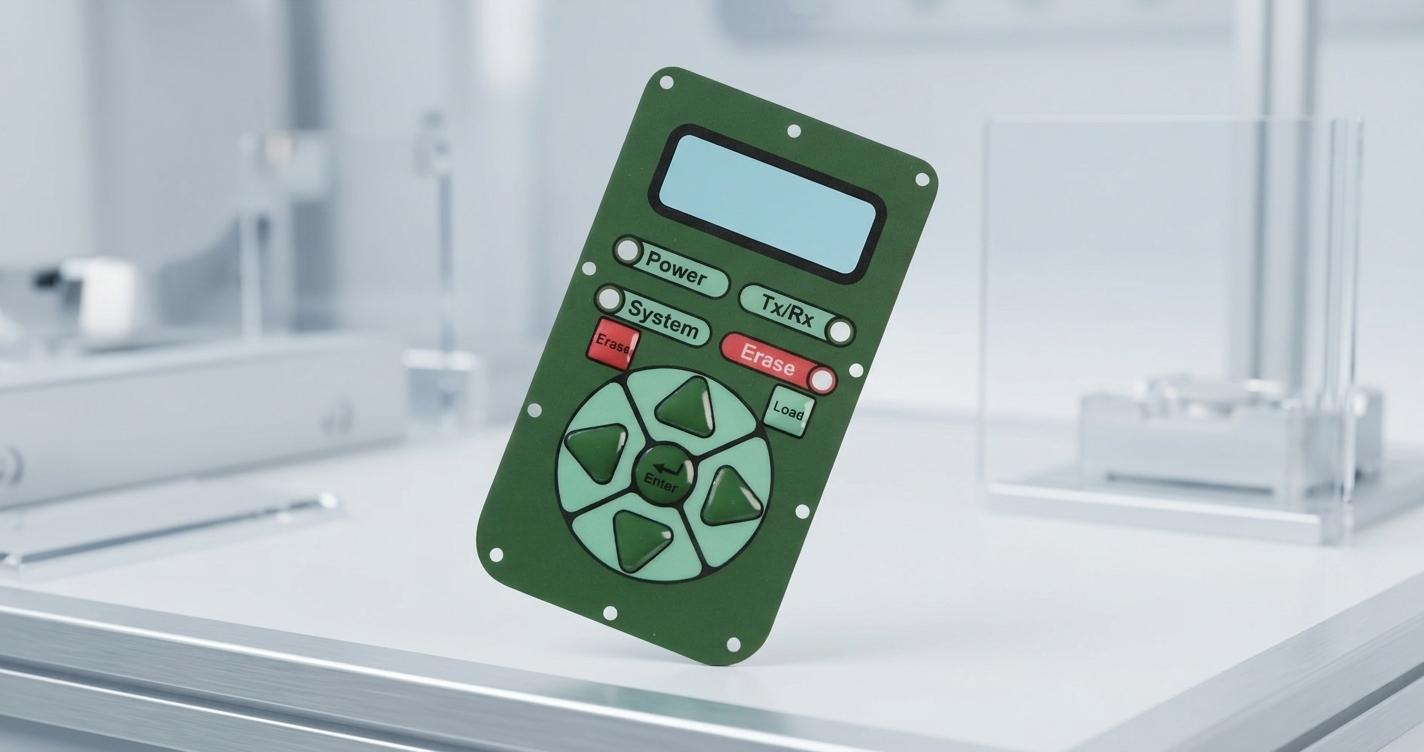
Keetronics ( India ) Pvt. Ltd. a leading custom membrane keypad manufacturers in India, is offering the best quality of membrane keypads that act as an interface between humans and machines. These are made with high-quality polyester (PET) and polycarbonate (PC) and have an individual switch or a key where the pressure has been applied with pads with printed circuits to register keystrokes.
A membrane keyboard is a type of computer keyboard or switch interface where the keys are not separate, moving mechanical parts, but rather pressure pads printed onto a continuous, flexible membrane surface.
How It Works
Instead of having individual physical switches under every key (like a mechanical keyboard), a membrane keyboard uses multiple flexible layers:
-
Top Layer: A printed graphical overlay (the key labels you see and press). Underneath this is a flexible layer with conductive traces printed on it.
-
Spacer / Gap Layer: An insulating layer with holes aligned under each key position to keep the top and bottom layers from touching when not pressed.
-
Bottom Layer: Another conductive layer printed with circuit traces.
When you press a key, the top flexible membrane is pushed down through the hole in the spacer layer, touching the bottom layer. This completes an electrical circuit, registering the keystroke.
Membrane Keyboards vs. Mechanical Keyboards
| Feature | Membrane Keyboard | Mechanical Keyboard |
| Feel / Feedback | Soft, squishy, or "mushy" feeling | Distinct tactile bump and click sound |
| Noise Level | Very quiet | Loud to moderate typing sounds |
| Price | Affordable and inexpensive to make | More expensive |
| Durability | Wears out faster (typically 5–10 million presses) | High durability (50–100 million presses) |
| Spill Resistance | Often easy to seal against water/dust | Vulnerable to liquid spills unless specially treated |
Common Uses
-
Standard Office Keyboards: Most budget desktop keyboards and laptop keyboards use a variant of membrane technology (often dome switches over a membrane).
-
Industrial & Medical Equipment: Sealed membrane keypads are widely used in hospitals, factories, and outdoor kiosks because they are waterproof, dustproof, and easy to sanitize.
-
Home Appliances: Microwave control panels, oven keypads, and washing machines frequently use membrane switches.
The manufacturing process of a membrane keyboard involves several specialized engineering steps, combining graphic printing, precise electrical trace deposition, mechanical forming, and multi-layer lamination.
1. Material Preparation & Thermal Pre-Treatment
-
Substrate Selection: Flexible polyester (PET) or polycarbonate films are chosen as the base layers due to their flexibility, durability, and resistance to heat/chemicals.
-
Heat Stabilization: The PET film rolls are baked in industrial ovens. Thermal pre-treatment prevents the film from shrinking or warping during subsequent printing and curing processes.
2. Graphic Overlay & Circuit Printing
-
Graphic Overlay Printing: The visual faceplate (containing button icons, text, and logos) is printed on the underside of a clear top film (reverse printing) using screen printing or digital printing. This protects the ink from wearing off during use.
-
Conductive Trace Deposition: Using precision screen printing, conductive silver and carbon inks are applied to the top and bottom membrane layers to create circuit traces and contact pads.
-
Thermal Curing: The printed layers pass through circulating hot-air conveyor ovens or UV curing stations to dry and solidify the conductive inks.
3. Tooling, Embossing & Component Placement
-
Embossing: To create physical key boundaries or raised buttons, the top graphic overlay undergoes hot/cold embossing or pillow embossing using custom dies.
-
Component Mounting (SMT): Surface-mount technology (SMT) installs small electronic components, such as surface-mount LEDs or resistors, directly onto conductive traces using conductive adhesive.
-
Tactile Dome Placement: For keyboards requiring tactile feedback, stainless steel "metal domes" or polyurethane domes are affixed over contact points on the circuit layer.
4. Precision Cutting & Hole Punching
-
Die-Cutting / Laser Cutting: High-precision CNC laser cutters or mechanical die-presses cut individual layers to shape, punch out connector tails, cut LED window frames, and punch venting holes.
-
Registration Holes: Alignment holes are punched into each sheet to ensure layers match up perfectly during final lamination.
5. Multi-Layer Lamination & Assembly
The separate layers are assembled in cleanroom environments to prevent dust contamination:
-
Bottom Circuit Layer: Placed on a rigid backer plate or PCB (if applicable).
-
Spacer Layer: A double-sided adhesive spacer film with cutouts corresponding to key locations is applied over the bottom layer.
-
Upper Circuit Layer: Aligned over the spacer.
-
Graphic Overlay: The printed faceplate with top adhesive is bonded to the upper circuit layer.
-
Machine Roll Lamination: High-pressure rollers eliminate trapped air bubbles and securely bond the adhesive layers together.
6. Testing & Quality Control
-
In-Circuit Testing (ICT): Automated testers verify electrical continuity, pinout connections, switch contact resistance, and LED functioning.
-
Tactile & Actuation Force Test: Domes and keys are spot-checked using force-deflection meters to ensure actuation feel matches design standards.
-
Environmental & Visual Inspection: Final visual inspections check for print clarity, dust specks, adhesive alignment, and proper sealing.
Membrane keyboards are popular across consumer electronics, industrial machinery, and medical devices due to several distinct advantages:
1. Cost-Effective
-
Lower Production Costs: They are significantly cheaper to manufacture than mechanical keyboards because they use printed circuit layers and flexible films rather than dozens of individual physical switches and complex circuit boards.
-
Budget-Friendly for Consumers: This makes them the go-to option for affordable bundled desktop keyboards, entry-level laptops, and high-volume commercial appliances.
2. Quiet Operation
-
Silent Typing: Because keys press down on soft rubber domes or flexible plastic films rather than clicking metal mechanisms, membrane keyboards produce minimal typing noise—ideal for quiet office environments, libraries, and late-night use.
3. Water, Dust, and Spill Resistance
-
Sealed Design: The top graphic layer forms a continuous, seamless surface without gaps around individual keys.
-
Easy Cleaning: Spillages, dust, and debris cannot easily penetrate the internal electronics. Industrial and medical membrane keypads can be sprayed down, wiped, and sanitized without damaging the underlying switches.
4. Lightweight and Compact
-
Slim Profile: Membrane layers are extremely thin and lightweight, making them perfect for ultra-thin laptops, portable tablets, and space-constrained industrial control panels.
5. Design Flexibility & Customization
-
Custom Interfaces: Manufacturers can print virtually any layout, graphic design, icon set, or color scheme onto the top overlay.
-
Integrated Features: Micro-LEDs, backlighting windows, and custom tactile embossing (raised button outlines) can easily be integrated directly into the membrane structure.
Keetronics (India) Pvt. Ltd. is a specialized manufacturer of Human-Machine Interface (HMI) solutions, custom membrane keyboards, and tactile keypads. Based in Pune, India, the company designs and manufactures custom input devices for defense, medical, marine, industrial automation, and automotive electronics.
Overview of Keetronics’ Manufacturing Focus
Keetronics specializes in custom-engineered, multi-layered membrane keypads tailored to specific client applications rather than standard mass-market computer keyboards.
Key Product Variants & Technologies
-
Tactile Metal-Dome Keypads: Incorporates stainless steel metal domes between circuit layers to provide distinct tactile feedback and high operational life (up to millions of actuations).
-
Illuminated / Backlit Membrane Keyboards: Integrates surface-mount LEDs or fiber-optic backlighting solutions into the flexible membrane structure for low-light or military applications.
-
PCB-Based Membrane Keyboards: Combines flexible graphic overlays with rigid FR4 Printed Circuit Boards (PCBs) for complex circuit designs and component mounting.
-
Rugged & Enclosed Keypads: Custom membrane panels attached to aluminum backplates or sealed enclosures rated up to IP65/IP67 for protection against water, oil, and dust ingress.
Keetronics' Manufacturing Capabilities & Process
-
Custom Graphic Design & Screen Printing: Uses reverse-screen printing or digital printing on polycarbonate or polyester (PET) films to ensure chemical resistance, print longevity, and clear legend display.
-
Embossing Options: Custom hot/cold embossing to create pillow, rim, or perimeter-raised keys that enhance tactile boundary recognition for operators.
-
Conductive Layering & SMT Assembly: Precision depositing of conductive silver/carbon inks onto PET layers and SMT placement of LEDs, resistors, and micro-connectors directly onto flexible substrates.
-
Precision Cutting & Environmental Sealing: Laser cutting and CNC die-cutting for exact housing fitments, complete with specialized pressure-sensitive adhesives (3M adhesives) to ensure dust- and liquid-tight seals.
-
Quality Control & Testing: Conducts 100% in-circuit testing (ICT), contact resistance checking, actuation force testing, and environmental testing (for high temperature, humidity, and vibration) prior to deployment.
