
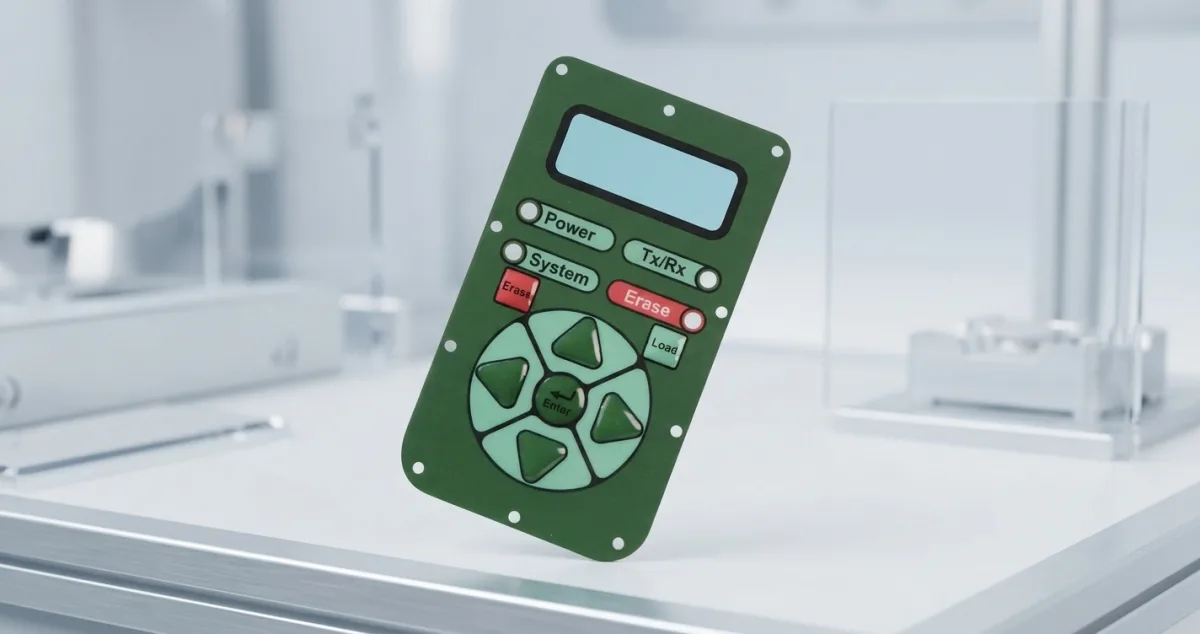
A flexible membrane keypad (or flexible membrane switch) is a thin, low-profile human-machine interface (HMI) used to control electronic equipment. Unlike traditional mechanical switches that rely on bulky moving parts,...
Depending on the design and application, a flexible membrane keypad with or without a connector is manufactured at Keetronics ( India ) Pvt. Ltd. The keys are placed between multiple layers of flexible polymer sheets that have been punched (usually polyester). This flexible membrane keypad is made in accordance with global quality standards utilising premium materials and cutting-edge technology. Conductive silver ink is silk-screened onto the top and bottom membrane layers of the polyamide circuits. Keypads that are affordable, dependable, and have an essential life of more than 2 to 5 million keystrokes are also lighter than a PCB. Flexible circuits enable product forms that stiff PCBs cannot support.
To address any immediate client requirement, we have full in-house production capabilities. We have a clean, controlled-temperature, well-ventilated, and non-hazardous facility that is ideal for producing membrane keypads. We take great care to reduce rejection at all production stages, including film exposure, printing, drying, and assembly. We have a tool area where we manufacture dyes and fixtures. Our automated label-cutting system is cost-effective, meets the necessary dimensional tolerances, and shortens delivery times.
These flexible polyamide keypads are frequently found in household appliances, communication systems, and industrial equipment. Our professionals rigorously test the offered keypad against several quality criteria to guarantee its perfection.
Key Components & Layer Structure
-
Graphic Overlay: The top visible surface printed with key labels, colors, icons, and branding. It often features protective coatings for UV, chemical, or moisture resistance.
-
Top Circuit / Contact Layer: A flexible film with printed conductive circuit traces on the underside.
-
Spacer Layer: An adhesive dielectric sheet with cutouts directly beneath each button location to keep the top and bottom contacts separated until pressed.
-
Bottom Circuit Layer: A matching flexible film printed with conductive traces facing up.
-
Backing Adhesive: A strong double-sided adhesive (such as 3M tape) used to mount the keypad securely onto an enclosure or housing.
How It Works
-
Pressing a Key: When a user applies pressure to a button on the graphic overlay, the top conductive circuit deflects downward through the cutout in the spacer layer.
-
Making Contact: The top conductive pad meets the lower circuit trace, completing the electrical circuit and sending a signal to the micro-controller.
-
Releasing the Key: Releasing pressure allows the flexible layer (or metal dome) to spring back into place, breaking the circuit connection.
Types of Membrane Keypads
-
Non-Tactile: Utilizes direct contact between printed conductive traces. It offers silent operation and a ultra-flat profile but provides no physical tactile feedback (often paired with an audible beep or LED light).
-
Tactile (Metal or Poly Dome): Incorporates stainless steel domes or thermoformed plastic domes beneath the overlay. Pressing down creates a distinct snap or "click" feel for tactile feedback.
Key Advantages
-
Compact & Low Profile: Extremely thin design suitable for space-constrained electronics.
-
Sealed & Durable: Protects against moisture, dust, oils, and chemical exposure, making it easy to clean and sanitize.
-
Cost-Effective: Economical to manufacture in volume compared to full mechanical switch assemblies.
-
Customizable: Fully customizable shapes, surface textures (embossing), lighting (LED integration), and graphic aesthetics.
Common Applications
-
Medical Devices: Patient monitors, diagnostic instruments, and control panels requiring frequent sterilization.
-
Industrial Controls: Manufacturing machinery, control panels, and automation interfaces exposed to dirt or fluids.
-
Consumer & Kitchen Appliances: Microwave ovens, washing machines, and treadmill consoles.
-
DIY & Microcontroller Projects: Standardized matrix keypads (like 4x4 or 3x4 layouts) used with Arduino, ESP32, or Raspberry Pi modules.
The manufacturing process of flexible membrane keypads involves several sequential stages, moving from custom graphical and electrical design to mechanical assembly and testing.
1. Design & Material Selection
-
Graphic Overlay Selection: Polyester (PET) or polycarbonate (PC) films are selected for the top layer based on environmental needs (PET offers superior flex life and chemical resistance; PC offers high transparency and ease of printing).
-
Circuit Circuitry Design: CAD software is used to lay out conductive traces, key matrices, pinouts, and spacer cutouts.
2. Screen Printing & Curing
-
Graphic Overlay Printing: The artwork, branding, text, and key outlines are printed onto the reverse side (underside) of the transparent film using screen printing or digital printing. Reverse printing protects the ink from wear and scratching.
-
Conductive Circuit Printing: Conductive inks (typically silver-filled ink for traces and carbon ink for contact pads to prevent silver migration) are screen-printed onto flexible polyester substrate films to form the upper and lower circuit layers.
-
Thermal Curing: Printed circuit sheets pass through drying ovens to cure the conductive ink, ensuring stable electrical resistance.
3. Key Embossing & Metal Dome Placement
-
Embossing: Heat and pressure dies deform the graphic overlay film to form raised button areas (rim embossing or pillow embossing) for physical key location guide.
-
Dome Placement (for Tactile Keypads): Stainless steel metal domes or thermoformed poly domes are positioned over the contact pads on the lower circuit layer using automated dome-placement machines or dome retainer sheets.
4. Precision Die-Cutting & Punching
-
Spacer Cutout Die-Cutting: Die-cutting machinery punches out window openings in double-sided adhesive sheets. These openings line up with button locations so top and bottom contacts can meet.
-
Outline Cutting: Laser cutters or steel-rule dies cut individual overlay sheets, circuit layers, and adhesive backings into precise final dimensions.
5. Multi-Layer Lamination & Assembly
-
Layer Alignment: Optical alignment tools align the printed overlay, top circuit, spacer adhesive, bottom circuit, and rear backing adhesive.
-
Lamination: Cold or hot pressure rollers press the layers together to form a sealed, multi-layer assembly.
-
Tail Termination: Flexible tail leads carrying circuit traces are terminated with crimp connectors (such as female pitch connectors or ZIF connectors) for micro-controller interface connection.
6. Quality Control & Testing
-
100% Electrical Testing: Automated test rigs test key matrix continuity, contact resistance, and insulation resistance across all key locations.
-
Tactile & Visual Inspection: Keypads are inspected for tactile force consistency (gram actuation force), registration accuracy, and surface finish defect-free coating.
Keetronics (India) Pvt. Ltd. is a prominent Pune-based manufacturer specializing in custom Human-Machine Interface (HMI) solutions, including high-durability flexible membrane keypads.
They manufacture both customized membrane keypads built to customer specifications and standard off-the-shelf control modules.
Key Technical Specifications & Build Features
-
Ultra-Thin Profile: Designed with overall stack profiles as thin as 1.0 mm to 1.5 mm, ideal for space-constrained electronics and handheld devices.
-
Conductive Layers: Constructed using Flexible Printed Circuits (FPC) with flexible copper or printed silver ink on polyester/PET substrates.
-
Environmental Protection: Front panels are sealed up to IP67 standards, providing protection against water, dust, chemicals, and aggressive sanitizing agents.
Tactile Options:
-
Metal Domes: High-grade stainless steel domes (gold/nickel plated) offering sharp tactile click feedback (250g–450g actuation force).
Poly Domes / Embossed Keys: Thermoformed plastic domes or rim-embossed overlays.
Non-Tactile: Flat layouts for silent operation.
-
-
ESD & EMI Shielding: Includes integrated foil layers to withstand up to 30 kV electrostatic discharge.
-
Illumination & Connections: Features ultra-thin integrated SMD LEDs under key windows and terminates with flexible FPC tails (1.0 mm or 2.54 mm ZIF pitch connectors).
Common Product Configurations
Need a custom HMI architecture for harsh operating conditions?
Talk to Our Team