
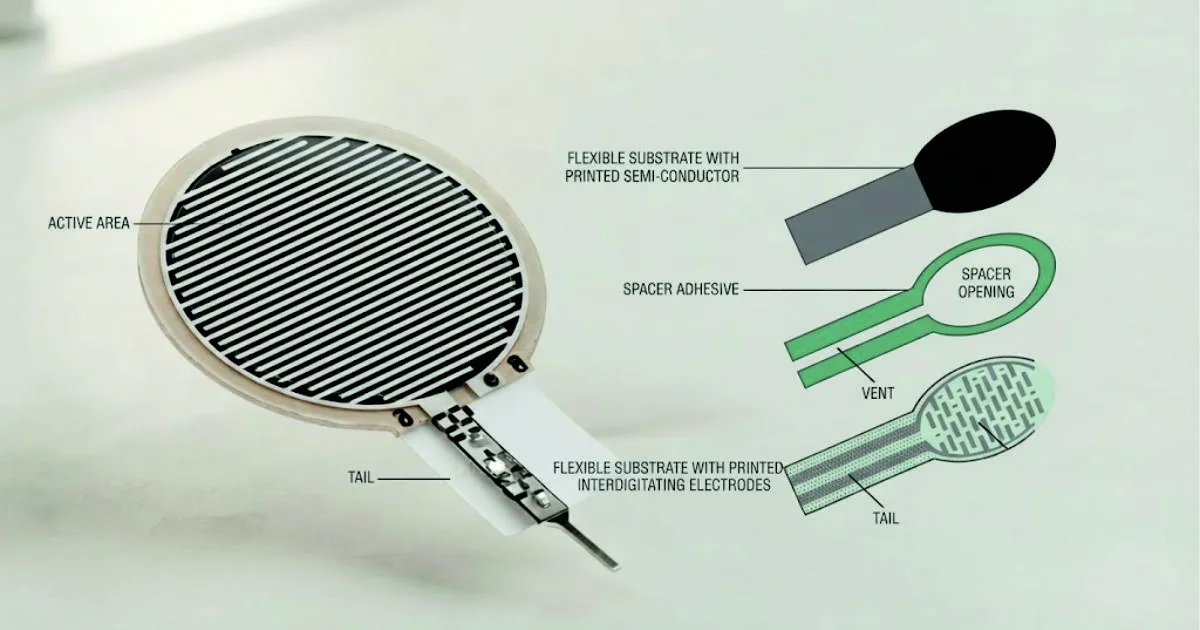
Force sensing resistor is highly sensitive to resistance when applied pressure. More the pressure applied, lower is the resistance. Force sensing resistors are produced through printing technology so are very thin an...
A Force Sensing Resistor (FSR) is a thin, flexible material whose electrical resistance changes when physical pressure, force, or mechanical stress is applied to its surface.
Essentially, it acts as a touch-sensitive variable resistor—the harder you press, the more its resistance drops.
How an FSR Works
FSRs are built using a piezoresistive sensing technology. They typically consist of several ultra-thin layers sandwiched together:
-
The Outer Layers: Flexible plastic or polyester films. One layer is printed with a set of interdigitating conductive fingers (electrodes) that don't quite touch each other.
-
The Active Layer: A layer coated with a semi-conductive polymer or carbon-based ink.
-
The Interaction: * When Unloaded: The semi-conductive ink doesn't press against the electrodes. The circuit remains open, resulting in a massive internal resistance (often over $1\text{ M}\Omega$).
-
When Force is Applied: The conductive particles in the ink are pushed against the electrodes, completing the circuit. As you press harder, more contact points are made, and the resistance drops dramatically—often down to a few hundred or thousand ohms ($k\Omega$).
-
Key Pros and Cons
Like any sensor, FSRs excel in certain scenarios but are poorly suited for others:
| Advantages (Pros) | Limitations (Cons) |
| Ultra-Thin & Flexible: Often less than 1 mm thick, making them easy to fit into tight spaces. | Low Absolute Accuracy: They are not ideal for precise weight scales. Their readings can vary by $10\%$ to $25\%$. |
| Inexpensive: Highly cost-effective compared to load cells. | Hysteresis: The sensor's reading might change slightly depending on whether the force is increasing or decreasing. |
| Simple to Interface: They don't require complex amplifiers; a basic voltage divider circuit is usually enough. | Part-to-Part Variation: Two identical-looking FSRs might have slightly different resistance curves. |
Common Applications
Because of their durability and slim profile, you can find FSRs in many everyday devices:
-
Musical Instruments: Electronic drum pads and MIDI keyboard controllers use them to measure velocity (how hard a key or pad is struck).
-
Consumer Electronics: Touchpads, handheld gaming controller buttons, and pressure-activated menu buttons.
-
Robotics: Placed on robotic grippers to provide tactile feedback so the robot knows when it has grabbed an object securely without crushing it.
-
Medical Devices: Smart insoles for gait analysis, prosthetic socket pressure mapping, and patient bed occupancy sensors.
Key Pros and Cons
Like any sensor, FSRs excel in certain scenarios but are poorly suited for others:
| Advantages (Pros) | Limitations (Cons) |
| Ultra-Thin & Flexible: Often less than 1 mm thick, making them easy to fit into tight spaces. | Low Absolute Accuracy: They are not ideal for precise weight scales. Their readings can vary by $10\%$ to $25\%$. |
| Inexpensive: Highly cost-effective compared to load cells. | Hysteresis: The sensor's reading might change slightly depending on whether the force is increasing or decreasing. |
| Simple to Interface: They don't require complex amplifiers; a basic voltage divider circuit is usually enough. | Part-to-Part Variation: Two identical-looking FSRs might have slightly different resistance curves. |
Common Applications
Because of their durability and slim profile, you can find FSRs in many everyday devices:
-
Musical Instruments: Electronic drum pads and MIDI keyboard controllers use them to measure velocity (how hard a key or pad is struck).
-
Consumer Electronics: Touchpads, handheld gaming controller buttons, and pressure-activated menu buttons.
-
Robotics: Placed on robotic grippers to provide tactile feedback so the robot knows when it has grabbed an object securely without crushing it.
-
Medical Devices: Smart insoles for gait analysis, prosthetic socket pressure mapping, and patient bed occupancy sensors.
Interfacing with a Microcontroller (Like Arduino)
Microcontrollers cannot read resistance directly; they read voltage. To use an FSR, you typically pair it with a fixed resistor (usually $10\text{ k}\Omega$) to create a voltage divider circuit.
As force is applied to the FSR, its resistance drops, causing the voltage at the junction between the two resistors to rise. This changing voltage is then read by the microcontroller's Analog-to-Digital Converter (ADC) pin.
Need a custom HMI architecture for harsh operating conditions?
Talk to Our Team