
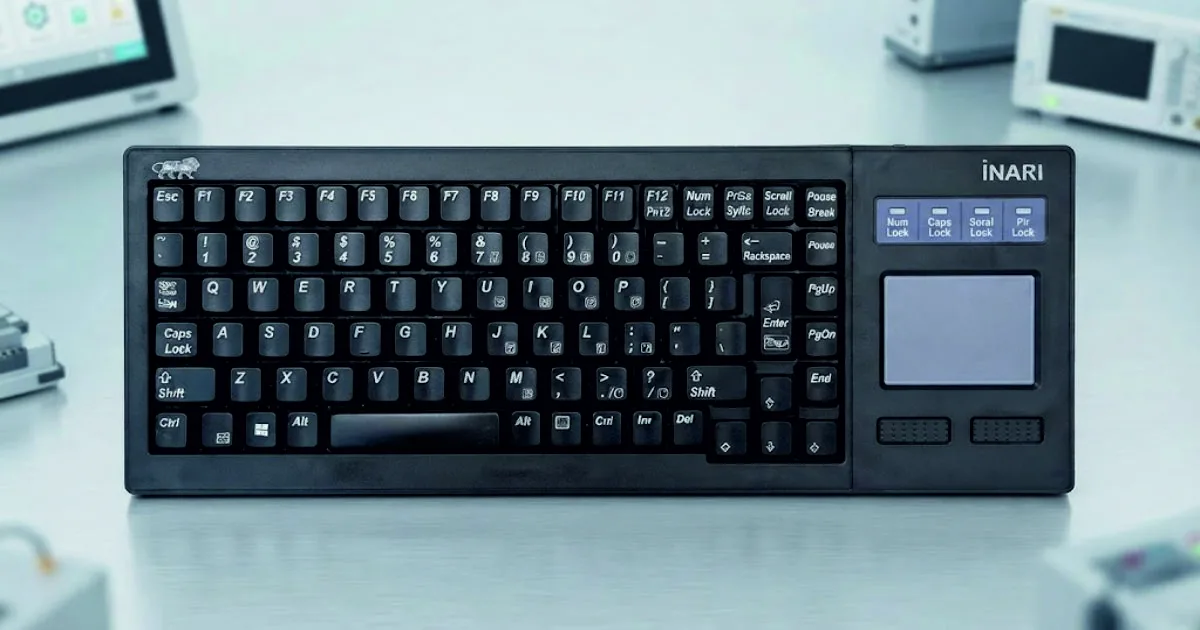
A mechanical keyboard uses a dedicated, physical spring-activated switch under every single key. Unlike standard membrane keyboards that use a soft rubber pad to register inputs, these switches provide distinct tactile....
At its core, a mechanical keyboard is a keyboard that uses an individual, physical spring-activated switch under every single key.
This is the main differentiator from standard, cheaper "membrane" keyboards, which use a single continuous rubber dome sheet to register keypresses when you bottom out the key.
Why People Prefer Mechanical Keyboards
· Longevity & Durability: Standard membrane keys degrade relatively quickly, whereas mechanical switches are rated for millions of keystrokes (often 50 to 100 million).
· The "Feel" and Feedback: Because of the physical switches, you get instant tactile or audible feedback the exact moment a key registers, meaning you don't always have to press the key all the way down to type. This can significantly reduce finger fatigue over long sessions.
· Deep Customization: You can easily swap out the keycaps (the plastic tops you look at) or even the switches themselves to completely change the sound, actuation force, and style of your board.
· Anti-Ghosting: They allow you to press multiple keys simultaneously without the keyboard locking up or missing inputs, which is highly valued for gaming and fast typing.
The Three Main Switch Types
The overall typing experience depends entirely on the type of switch you choose. They generally fall into three categories:
|
Switch Type |
Characteristics |
Best Used For |
|
Linear |
Smooth, quiet, and consistent from top to bottom with no tactile bump. |
Fast-paced gaming where speed is key. |
|
Tactile |
Features a subtle physical "bump" mid-keypress so you feel exactly when it registers. |
A balance of typing and casual gaming. |
|
Clicky |
Provides both a physical bump and a loud, sharp "click" sound. |
Enthusiast typists who love loud audio feedback. |
Manufacturing a mechanical keyboard is a multi-step process that combines industrial design, chemistry, materials science, electrical engineering, and precise automated assembly. Unlike mass-market membrane keyboards, which are made primarily from stamped plastic and rubber sheets, mechanical keyboards are built from discrete, high-durability components.
The complete manufacturing process can be broken down into six main stages:
1. Design and Prototyping
Before production begins, engineers map out the keyboard layout (e.g., Full-size, TKL, 60%) using Computer-Aided Design (CAD) software.
· PCB Matrix Layout: Engineers map the trace matrix on the Printed Circuit Board to ensure electrical pathways handle anti-ghosting and key rollover seamlessly.
· Acoustic & Structural Engineering: High-end keyboard designers pay distinct attention to internal acoustics. Prototypes are often 3D printed or CNC-machined out of cheap plastics to test typing angles, internal clearances, and sound dampening.
2. The Brains: PCB Assembly (PCBA)
The Printed Circuit Board (PCB) acts as the central nervous system of the keyboard.
· Trace Printing: Conductive copper pathways are etched onto a rigid fiberglass board (typically FR4).
· Surface Mount Technology (SMT): High-speed "pick-and-place" robotic arms position microscopic components—like diodes (to prevent ghosting), resistors, RGB LEDs, and the central microcontroller—onto the board.
· Reflow Soldering: The PCB passes through a high-temperature reflow oven, melting pre-applied solder paste to permanently fuse all electronic components to the board.
3. The Enclosure: Case Manufacturing
The outer shell of the keyboard defines its aesthetic, weight, and acoustic profile. The manufacturing method splits based on the market tier:
· Mass Market (Injection Molding): For standard consumer keyboards, plastic pellets—usually ABS (Acrylonitrile Butadiene Styrene)—are melted and injected at high pressure into precision steel molds. This process takes only seconds per case and is highly cost-effective.
· Premium / Enthusiast Market (CNC Milling): High-end keyboard chassis are carved from solid blocks of aerospace-grade aluminum (often 6063 aluminum) using 5-axis CNC (Computer Numerical Control) machines. The cases are then bead-blasted to achieve a smooth matte texture and anodized chemically to give them permanent color and scratch resistance.
4. Switch Manufacturing
The physical switch under each key is a miniature mechanical marvel, usually manufactured in separate dedicated factories (like Cherry, Gateron, or Kailh):
· Stamping Contact Leafs: High-precision stamping presses punch out the delicate copper leaves that close the circuit when pressed.
· Injection Molding Stems and Housings: The upper housing, lower housing, and colored stem (which determines if the switch is linear, tactile, or clicky) are injection-molded out of low-friction plastics like POM, Nylon, or Polycarbonate.
· Automated Assembly & Lubing: Specialized high-speed machines drop the bottom housing, drop in the precision-coiled steel spring, insert the stem and copper leaves, apply microscopic amounts of factory lubricant, and snap the housing closed.
5. The Interface: Keycap Manufacturing
Keycaps require high durability because they take direct impact from fingers. They are manufactured using one of two plastic compounds: ABS (smooth, vibrant colors, but develops a greasy shine over time) or PBT (textured, matte, highly resistant to wear).
The legends (the letters printed on top) are applied using three primary industrial methods:
· Pad Printing: An ink stamp presses the letter onto the cap. This is inexpensive but wears off over time.
· Dye-Sublimation: High heat forces dye directly into the pores of PBT plastic, creating a permanent bond.
· Double-Shot Injection Molding: The absolute gold standard. The keycap is molded twice using two separate colors of plastic. The letter itself is actually a structural piece of plastic running all the way through the cap, meaning it can literally never rub off or fade.
6. Final Assembly and Quality Control (QC)
Once all components are manufactured, they converge at the assembly line:
1. Plate & Switch Installation: A metal or polycarbonate plate is layered over the PCB. The individual switches are snapped into the plate and either pushed into hot-swap sockets or wave-soldered directly onto the PCB.
2. Case Enclosure: The completed PCB-plate assembly is screwed or gasket-mounted into the chassis.
3. Keycap Seating: Automated pneumatic arms or human workers press the completed keycaps onto the switch stems.
4. Testing: The completed keyboard undergoes rigorous quality control. Automated testing machines press every single key to verify the electrical connection, check the firmware, and sometimes test the acoustics in isolated sound chambers to ensure consistency.
Keetronics (India) Pvt. Ltd. is a pioneering Indian manufacturing company specializing in advanced electronics, custom Human-Machine Interface (HMI) solutions, and input devices. Established in 1994, the company has over 32 years of industry experience and has completed more than 7,000 projects globally.
Keetronics designs, develops, and manufactures high-quality custom interfaces and automation hardware, including:
- Industrial Input Devices: PCB & PCF membrane switches, rugged customized computer keyboards, and metallic industrial keyboards.
- HMI & Displays: Customized rugged industrial touch displays and HMI solutions tailored for harsh environments.
- Smart Automation: Smart touch switches for homes, offices, and hotels, alongside custom embedded solutions.
- Specialized Industries: High-reliability input devices engineered specifically for defense, military, aerospace, medical, and marine applications.
Keetronics designs, develops, and manufactures high-quality Mechanical keyboards
Need a custom HMI architecture for harsh operating conditions?
Talk to Our Team