Loading...
Blog / Article
Engineering Insight Updated June 2026

Standard Matrix Keyboards

Standard Matrix Keyboards

Standard matrix keyboards are efficient input devices that arrange keys in a grid of rows and columns. By sharing lines rather than giving each key its own dedicated wire, they drastically reduce the number of required...

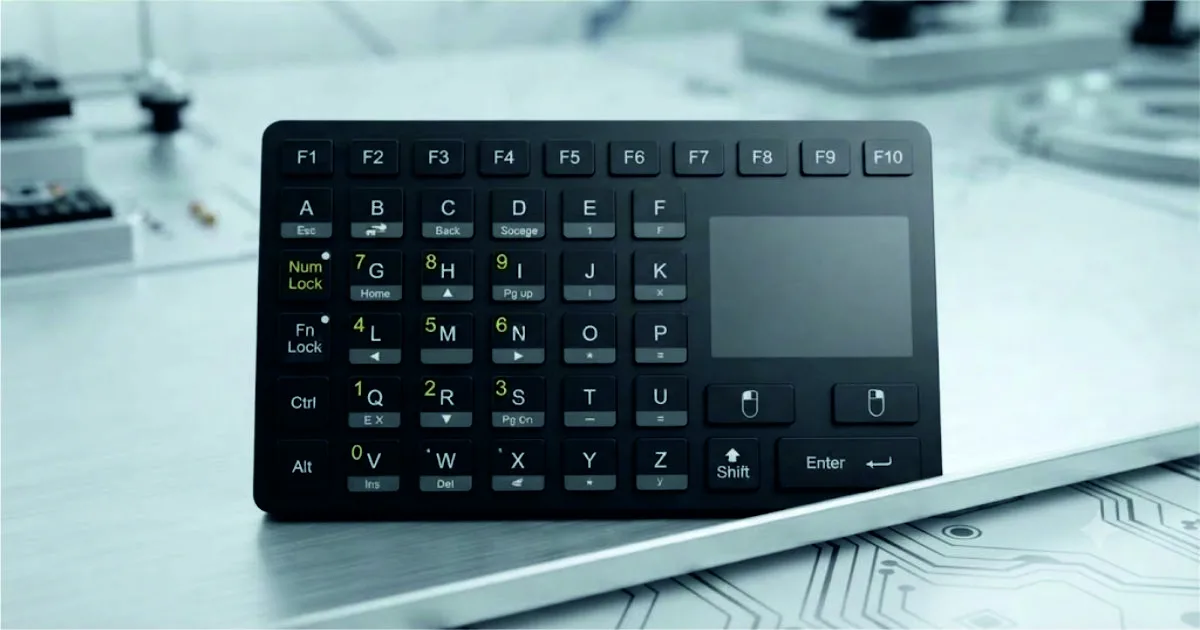
A Standard Matrix Keyboard is not a specific type of physical keyboard you buy at a store; rather, it refers to the internal electrical wiring system used by almost all modern computer keyboards, calculators, and keypads.

Instead of running a separate wire from every single key to the computer's processor (which would require over 100 individual wires), a matrix keyboard wires the keys into a grid of Rows and Columns.

How the Matrix Works

Inside the keyboard, the circuit board (PCB) or plastic membrane creates an intersecting grid. For example, a standard 104-key keyboard might be wired into an electrical grid of 16 columns and 8 rows.

Column 1    Column 2    Column 3
               |           |           |
Row 1 ---------+-----------+-----------+---- [Key A]
               |           |           |
Row 2 ---------+-----------+-----------+---- [Key B]
               |           |           |
 
  • The Scan: The keyboard’s internal controller chip rapidly sends an electrical current down the columns, one by one, dozens of times per second.

  • The Press: When you press a key, it bridges a physical gap, connecting a specific row to a specific column.

  • The Detection: If the controller sends power down Column 3 and feels that power return on Row 2, it instantly looks at its internal "map" and says, "Ah, Column 3 + Row 2 equals the 'B' key."

Why Use a Matrix? (The Math)

The primary reason for using a matrix is efficiency and cost.

  • Without a Matrix: A 104-key keyboard would need 104 separate input pins on the controller chip and 104 individual wires running across the board. This would make the chips massive, expensive, and the wiring incredibly complex.

  • With a Matrix: By using an $8 \times 16$ grid, the keyboard only needs 24 pins ($8 + 16$) to monitor all 104 keys.


The Limitation: "Ghosting" and "Jamming"

While standard matrix wiring is incredibly efficient, it has a physical limitation when you press multiple keys at the same time (common in gaming or fast typing):

  • Ghosting: If you press three keys that form three corners of a rectangle in the matrix grid (e.g., Row 1/Col 1, Row 1/Col 2, and Row 2/Col 1), the electrical current can backflow. The controller gets confused and thinks the fourth corner of the rectangle was also pressed—creating a "ghost" keypress that you never actually touched.

  • Jamming (Key Blocking): To prevent ghosting, standard keyboard manufacturers program the controller to simply ignore third or fourth simultaneous keypresses. This is why a standard keyboard might stop registering inputs if you mash too many keys at once.

The Fix: High-end mechanical and gaming keyboards modify the standard matrix by adding a tiny diode to every single key switch. This acts as a one-way valve for electricity, preventing backflow entirely and allowing for N-Key Rollover (NKRO)—meaning every single key can be pressed simultaneously without error.


Where Are They Found?

Because they are cheap, reliable, and easy to manufacture, standard matrix systems are used in:

  • Desktop and laptop keyboards.

  • ATMs and point-of-sale terminals.

  • Calculators and microwave control panels.

  • Electronic musical keyboards (MIDI controllers).


Need a custom HMI architecture for harsh operating conditions?

Talk to Our Team
Share

Ready to Transform Your
Ideas into Reality?

Partner with us for innovative HMI solutions tailored to your needs

Quick Turnaround
Quality Assured
Custom Solutions
32+
Years
Experience
7000+
Projects
Completed
1000+
Satisfied
Clients

Trusted by leading organizations across defence, medical, industrial, and railway sectors worldwide.