
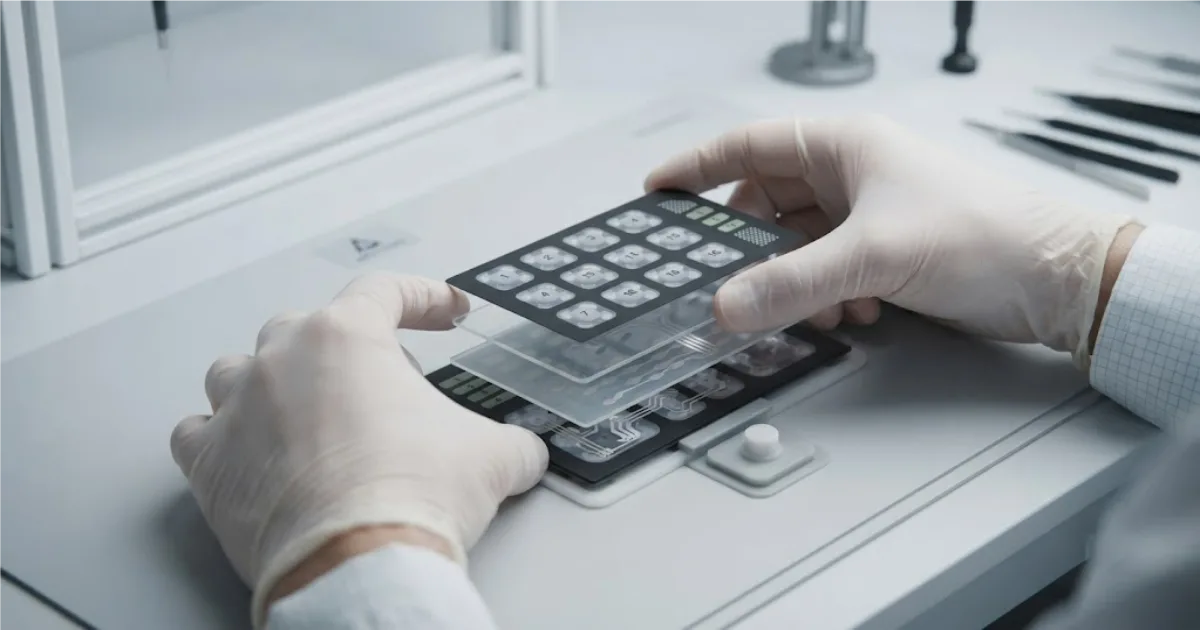
A tactile metal dome switch (or snap dome switch) is a momentary electrical switch that uses a collapsed stainless steel dome to complete a circuit. When pressed, the dome snaps inward, providing a distinct tactile "cli...
TACTILE METAL DOME SWITCH It Works
1. At Rest (Normally Open): The metal dome sits directly above the circuit traces on a Printed Circuit Board (PCB) or flexible circuit. The dome is slightly curved upward, meaning the circuit is open.
2. Actuation (Pressed): When you press down on the switch, the dome collapses or "snaps" downward. This physical inversion pushes the metal into direct contact with the circuit traces below, bridging the gap and completing the electrical path.
3. Release: The moment you let go, the natural elasticity of the stainless steel causes it to immediately spring back to its original curved position, breaking the circuit.
Key Characteristics & Benefits
· Tactile and Audible Feedback: The definitive "snap" provides the user with clear physical feedback (a distinct bump and an audible click), confirming the button press was successful without needing to look.
· Low Profile: Because they eliminate the need for bulky, traditional mechanical plastic plungers, metal domes are incredibly thin. This makes them perfect for ultra-slim electronic devices.
· High Durability: Built from high-quality stainless steel, these domes are incredibly resilient. Depending on the design, they are typically rated for anywhere from 1 million to over 10 million cycles.
· Versatility: They come in various shapes (four-legged, triangle, round, or oblong) and can be plated with gold, nickel, or silver to optimize electrical conductivity.
TACTILE METAL DOME SWITCH Common Applications
Because they balance low-profile sizing with long-lasting tactile feedback, you can find them in a massive variety of everyday tech:
· Consumer Electronics: Microwave control panels, computer mice, calculator keys, and washing machines.
· Automotive: Keyless entry key fobs, steering wheel controls, and dashboard buttons.
· Medical Equipment: Handheld diagnostic tools and hospital bed controllers where feedback and reliability are critical.
· Gaming: The underlying buttons in video game controllers and handheld consoles.
The manufacturing process of a tactile metal dome switch is a highly controlled, high-precision engineering sequence. Because these miniature components must endure millions of presses without losing their shape or "snap" tension, the manufacturing steps must focus heavily on material integrity and dimensional precision.
Step 1: Material Selection
The process begins with selecting high-grade raw metals. The most common choice is stainless steel (usually SUS301 or SUS304) because of its exceptional fatigue resistance and tensile strength. Other materials like nickel-plated phosphor bronze or beryllium copper are sometimes selected for specialized electrical properties.
At this stage, the metal is delivered in ultra-thin, continuous coils or sheets.
Step 2: Plating and Coating (Optional)
To lower contact resistance and protect against oxidation, the metal coils may go through a plating process.
- Plating options: Gold, silver, or nickel is chemically or electrolytically plated onto the metal.
- Placement: Plating can be applied to the entire surface or selectively on the underside (contact side) of the dome to optimize cost.
Step 3: High-Precision Stamping (Blanking & Forming)
Using high-speed, automated progressive die stamping presses, the flat metal sheet is shaped.
- Blanking: The machine punches out the flat, 2D outline of the dome (e.g., circle, four-legged cross, triangle, or oblong shape).
- Forming: A high-precision male/female forming die presses down on the blanked shape to create the precise dome curvature.
- Features (Dimples/Legs): During this stage, optional features like a center "dimple" (which concentrates force and protects contacts) or specific leg shapes are formed.
Why Precision Matters: The height, diameter, and curvature defined during this step directly dictate the dome's actuation force (the pressure needed to press it) and tactile ratio (how crisp the "snap" feels). Even a micrometer of variance can ruin the tactile feedback.
Step 4: Heat Treatment (Stress Relieving)
Cold stamping introduces immense internal stress to the metal. To ensure the dome recovers its shape millions of times without cracking or losing its spring:
- The stamped domes are placed in industrial ovens for heat treatment (tempering).
- This process relieves internal material stresses, hardens the steel, and locks in the physical memory of the dome shape.
Step 5: Cleaning and Surface Finishing
To ensure no manufacturing lubricants, oils, metal shavings, or dust remain on the contact surfaces:
- The domes undergo ultrasonic cleaning in specialized chemical baths.
- They are dried thoroughly to prevent any micro-corrosion before packaging.
Step 6: Quality Control and Testing
Manufacturers run a battery of tests on random samples from each batch:
- Life-Cycle Testing: Automated machines repeatedly press the domes to ensure they can survive their rated lifespan (often between 1 to 5+ million cycles).
- Force-Travel (F-D) Curve Testing: Measures the exact force required to collapse the dome, verifying that the physical "click" meets specification.
- Electrical Resistance Testing: Ensures the contact resistance meets low-ohm requirements when collapsed.
Step 7: Packaging and Assembly
Depending on how the customer intends to install them, the finished domes are packaged in one of three ways:
|
Packaging Method |
Description |
Best For |
|
Bulk/Loose Domes |
Shipped loose in jars or bags. |
Manual placement or automated gravity-feed systems. |
|
Tape & Reel |
Loaded individually into pockets of a plastic carrier tape wound on a reel. |
High-speed automated Pick-and-Place SMT assembly lines. |
|
Dome Arrays (Peel-N-Place) |
Multiple domes pre-aligned on a custom, pressure-sensitive adhesive carrier sheet. |
Fast, manual, or semi-automated placement of entire keypads onto PCBs in one step. |
Keetronics (India) Pvt. Ltd. is a pioneering Indian manufacturing company specializing in advanced electronics, custom Human-Machine Interface (HMI) solutions, and input devices. Established in 1994, the company has over 32 years of industry experience and has completed more than 7,000 projects globally.
Keetronics designs, develops, and manufactures high-quality custom interfaces and automation hardware, including:
- Industrial Input Devices: PCB & PCF membrane switches, rugged customized computer keyboards, and metallic industrial keyboards.
- HMI & Displays: Customized rugged industrial touch displays and HMI solutions tailored for harsh environments.
- Smart Automation: Smart touch switches for homes, offices, and hotels, alongside custom embedded solutions.
- Specialized Industries: High-reliability input devices engineered specifically for defense, military, aerospace, medical, and marine applications.
Keetronics designs, develops, and manufactures high-quality TACTILE METAL DOME SWITCH
Need a custom HMI architecture for harsh operating conditions?
Talk to Our Team