
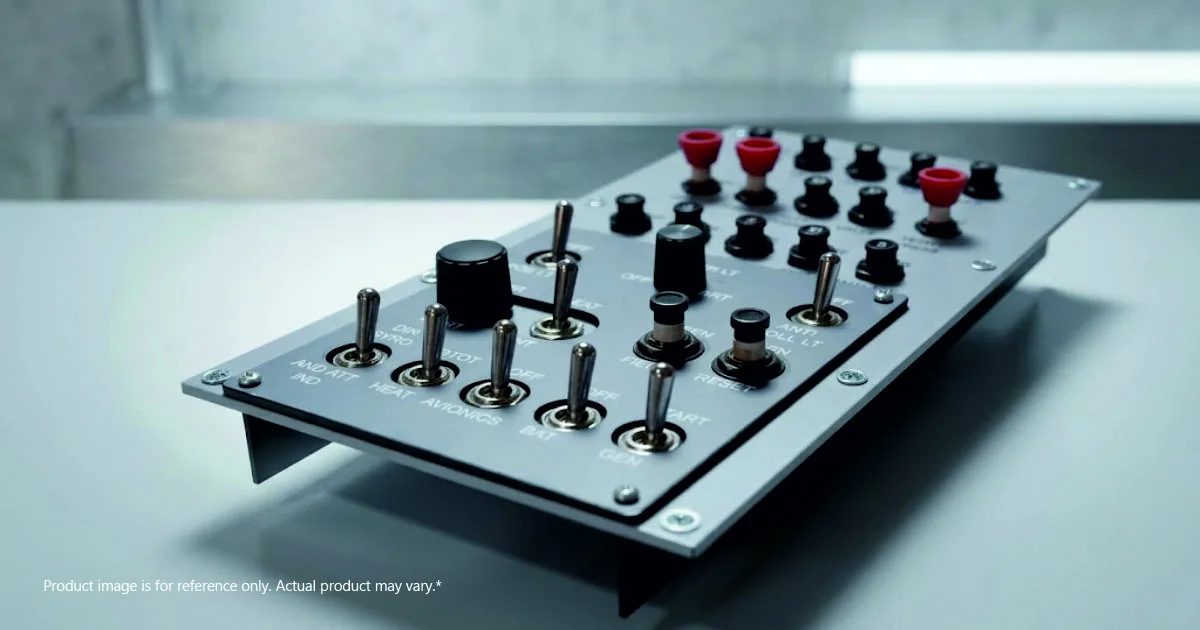
Vibration-proof testing rigs for switches are specialized systems designed to validate the reliability, durability, and trip points of industrial or aerospace switches under extreme mechanical stress. These test rigs si...
Vibration-proof testing rig switches are highly ruggedized, heavy-duty control mechanisms specifically designed to operate reliably under extreme mechanical stress and rapid oscillations without falsely tripping, failing, or suffering from signal degradation.
Unlike standard industrial switches, these are built to withstand the punishing environments found on electromechanical shaker tables, engine test cells, and automotive/aerospace test rigs.
Vibration-proof testing rig switches Characteristics & Engineering
To survive constant, high-frequency shaking, these switches utilize specific design standards:
· Chatter Prevention: Standard switches can suffer from "contact chatter" (micro-interruptions where the electrical connection rapidly opens and closes due to vibration). Vibration-proof switches use heavy-duty contacts, gold-flashed or bifurcated contact points, and high-tension internal springs to maintain a solid connection.
· Rugged Construction: They often feature military-grade (MIL-SPEC) locking levers, heavy-duty housings, or snap-action contact blocks to ensure the switch remains physically in its intended position.
· Environmental Ratings: Because testing rigs can involve heat, oil, or pressure, these switches frequently carry robust ingress protection and environmental ratings like IP66/IP67, NEMA 4X, or explosion-proof certifications for hazardous testing zones.
Primary Applications in Testing Rigs
In a testing environment, these switches generally serve two roles:
1. System Control: They safely manage the operation of the rig itself—such as changing motor speeds, toggling testing modes (e.g., switching between sine and random vibration profiles), or engaging hydraulic actuators.
2. Safety Cutoffs / Emergency Stops: They function as critical safety limits, automatically halting a test or overriding the system if the rig detects excessive g-forces, structural resonance, or thermal anomalies that could destroy the testing equipment.
Vibration-proof testing rig switches : Tested and Validated
Because these components are responsible for protecting expensive machinery, they must be validated themselves. Manufacturers and engineers test them using portable vibration shaker tables (such as the [Modal Shop 9100D](https://www.modalshop.com › vibration-switch-validation)) or signal conditioners. The switch is mounted to the table, and the frequency and velocity levels (measured in g-forces) are increased to ensure the switch triggers precisely at its intended alert/alarm threshold without experiencing premature mechanical failure.
The making process of vibration-proof testing rig switches varies significantly depending on whether the switch is mechanical (using physical inertial latching) or electronic (using a digital accelerometer and microprocessors). Both types are manufactured to withstand heavy mechanical stress, but their assembly and components differ.
1. Mechanical Vibration-Proof Switches (Inertial/Magnet-Latch)
Mechanical switches rely on a spring-loaded mass held by a magnet. When vibration levels exceed a set threshold, the inertia overcomes the magnetic force, releasing the latch and tripping the switch.
Phase A: Component Fabrication
· Heavy-Duty Cast Housing: Housings are typically cast from explosion-proof, marine-grade copper-free aluminum or glass-fiber reinforced polyester. They undergo precision CNC machining to create sealed threads for conduit entries.
· Spring and Latch Machining: The internal leaf springs and calibration latch mechanisms are stamped from highly resilient, fatigue-resistant alloys (such as beryllium copper or stainless steel) to prevent deformation over millions of vibration cycles.
· Plating and Coating: Contacts are plated with precious metals (such as gold or silver) to prevent oxidation, while the exterior housing is finished with heavy-duty epoxy powder coating to resist corrosion.
Phase B: Assembly & Magnet Calibration
· Inserting the Magnetic Core: A high-coercivity permanent magnet is mounted onto the spring-loaded lever arm.
· Contact Block Integration: Standard SPDT (Single Pole Double Throw) double-make leaf contacts are fitted into the switch chamber.
· Air-Gap Adjustment Integration: A precision threaded bolt or potentiometer screw is installed. This allows users to manually adjust the physical air gap between the magnet and the latch plate, directly altering the vibration "G-force" trigger threshold (typically 0 to 7 Gs).
2. Electronic Vibration-Proof Switches (Digital/Smart)
Modern testing rigs rely on electronic switches (like those manufactured by Keetronics ( India ) pvt. Ltd ). Because they have no moving parts, they do not wear out under high-frequency oscillations.
Phase A: Circuit Board (PCB) Fabrication
· Sensor Integration: A highly accurate piezoelectric accelerometer is surface-mounted (SMT) onto a multi-layer circuit board. This sensor converts mechanical vibration forces into minute electrical charges.
· Microcontroller & Relay Setup: Solid-state relays, analog-to-digital converters (ADCs), and microcontrollers are soldered to the PCB. These are programmed to calculate root-mean-square (RMS) velocity, peak acceleration, or displacement in real-time.
Phase B: Hermetic Sealing & Ruggedization
· Potting/Colloid Injection: To prevent vibration from shearing the components off the circuit board, the entire assembled PCB is placed in its housing and completely encapsulated in a specialized polymer potting gel or epoxy. This absorbs shock and makes the assembly impervious to moisture.
· Laser Welding: The outer stainless steel or aluminum capsule is hermetically laser-welded shut to achieve IP67/IP68 ingress protection.
Keetronics (India) Pvt. Ltd. is a pioneering Indian manufacturing company specializing in advanced electronics, custom Human-Machine Interface (HMI) solutions, and input devices. Established in 1994, the company has over 32 years of industry experience and has completed more than 7,000 projects globally.
Keetronics designs, develops, and manufactures high-quality custom interfaces and automation hardware, including:
- Industrial Input Devices: PCB & PCF membrane switches, rugged customized computer keyboards, and metallic industrial keyboards.
- HMI & Displays: Customized rugged industrial touch displays and HMI solutions tailored for harsh environments.
- Smart Automation: Smart touch switches for homes, offices, and hotels, alongside custom embedded solutions.
- Specialized Industries: High-reliability input devices engineered specifically for defense, military, aerospace, medical, and marine applications.
Keetronics designs, develops, and manufactures high-quality Vibration-proof testing rig switches
Need a custom HMI architecture for harsh operating conditions?
Talk to Our Team