
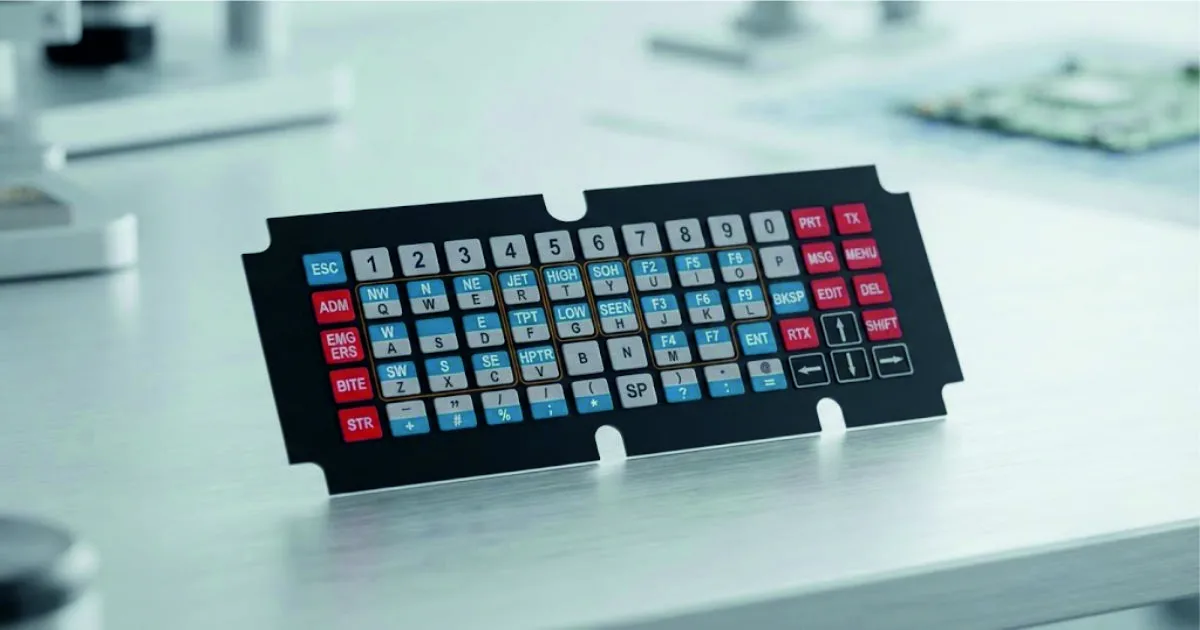
Membrane keyboards use a continuous flexible rubber or silicone layer under the keys to register presses, rather than individual mechanical switches. They are exceptionally quiet, spill-resistant, and highly affordable,...
A membrane keyboard is a computer keyboard where the keys are not separate, moving plastic parts (like on a mechanical keyboard) but are instead pressure pads integrated into a flat, flexible surface. They rely on electrical contact between the keyboard surface and underlying circuits when a key is pressed.
Here is a breakdown of how they work, their distinct types, and their pros and cons.
How It Works
Instead of using individual mechanical switches for every single key, a membrane keyboard typically uses three main layers stacked together:
- Top Membrane Layer: Underneath the keycaps (or printed graphic overlay), there is a flexible plastic layer with conductive traces printed on its underside.
- Spacer Layer: A middle layer made of insulating material with holes corresponding to each key position. It keeps the top and bottom layers apart when keys are not being pressed.
- Bottom Membrane Layer: A lower flexible layer with matching conductive traces printed on the top side.
When you press a key, you push the top layer down through the hole in the spacer layer. The conductive traces on the top and bottom layers touch, closing the electrical circuit and sending a signal to your device that a key has been pressed.
The Two Main Types of Membrane Keyboards
Depending on the design and intended application, membrane keyboards generally fall into two categories:
1. Flat Panel / Graphic Membrane Keyboards
- Design: These have no individual protruding moving keys. Instead, the keys are printed directly onto a flat, continuous plastic sheet (polyester or polycarbonate).
- Tactile Feedback: Very little to none, though some use embedded metal domes ("snap domes") under the sheet to give a slight physical "click."
- Best For: Industrial machinery, microwave control panels, medical equipment, and TV remotes. Because they are completely sealed, they are highly resistant to water, dirt, and chemicals.
2. Dome-Switch Keyboards (Consumer/Desktop)
- Design: This is the most common type used for modern desktop computers and laptops. They feature standard, individual plastic keycaps that sit on top of a flexible rubber or silicone "dome" sheet.
- Tactile Feedback: When you press the keycap, the rubber dome underneath collapses, providing a soft, mushy tactile response while pushing the conductive membrane layers together.
- Best For: Everyday office typing, standard laptops, and budget gaming setups.
Membrane vs. Mechanical Keyboards
|
Feature |
||
|
Actuation Mechanism |
Pressure closes a circuit on a flexible sheet. |
Individual, spring-loaded physical switches under each key. |
|
Feel / Feedback |
Soft, quiet, and slightly "mushy." |
Crisp, tactile, and often accompanied by an audible "click." |
|
Lifespan |
~5 to 10 million keystrokes (rubber degrades over time). |
~50 to 100 million keystrokes (highly durable springs). |
|
Cost |
Inexpensive to manufacture and buy. |
Premium pricing due to complex individual parts. |
|
Water/Dust Resistance |
High (especially industrial flat panels, which can be fully sealed). |
Low (liquids can easily damage individual switches). |
Summary of Pros and Cons
Pros:
· Affordable: Much cheaper to mass-produce than mechanical or optical variants.
· Quiet Operation: The rubber domes muffle sound, making them ideal for shared office environments.
· Lightweight & Portable: Can be built incredibly thin, making them the standard choice for laptops and travel-friendly folding keyboards.
· Easy to Clean/Seal: Flat panel variants can be easily wiped down and sanitized, making them essential in hospitals and factories.
Cons:
· Key Rollover Limits: They often suffer from "ghosting," meaning they struggle to register multiple simultaneous keypresses (a downside for high-end gaming).
· Typing Fatigue: Because you usually have to press the key all the way down ("bottoming out") to complete the circuit, it can feel heavier on the fingers during long typing sessions.
· Shorter Lifespan: The rubber membranes stretch and wear out over time, leading to keys feeling stiffer or losing responsiveness.
Keetronics (India) Pvt. Ltd. offer a dominant top best membrane keyboards manufacturers in India, and suppliers in India, which are made with new technological features inside and come in multiple types that can be used in various applications.
Keetronics (India) Pvt. Ltd. is an industry-leading pioneer in India's printed electronics and Human-Machine Interface (HMI) market. Founded in 1994 and headquartered in Kothrud, Pune, the company has grown into a highly specialized technology partner for defense, healthcare, railways, and industrial automation sectors over the last 30+ years.
Unlike standard mass-market computer keyboards, Keetronics designs and engineers custom, high-reliability input systems and control interfaces built to perform steadily in harsh environments.
1. Product Portfolio & Engineering Offerings
Keetronics operates end-to-end prototyping and production lines for a vast array of tailored input setups:
· Tactile & Non-Tactile Membrane Keyboards: Available in flexible silver-flex circuits or highly stable, rigid Glass Epoxy PCB bases. Their tactile keyboards use gold or nickel-plated metal dome switches rated for up to 1 million actuations across temperature thresholds ranging from $-20^\circ\text{C}$ to $+70^\circ\text{C}$.
· Kee-Lite Illuminated Keyboards: A proprietary backlighting solution integrated inside incredibly thin membrane profiles, ideal for darkened environments or clear panel guidance.
· PCB & PCF-Based Keyboards: High-durability layouts featuring direct switch integration onto printed circuit layers, maximizing anti-ghosting capabilities and preventing internal shorting.
· DuraSwitch® & Long-Travel Keyboards: Specialized structures designed for heavy industrial operations that require distinct mechanical key travel alongside completely flat, sealed faceplates.
· Capacitive Touch Switches ("Touchmatik"): Smart glass or acrylic-topped capacitive panels providing clean, flat, and sterile touch controls rather than traditional physical push-buttons.
· Vandal-Proof & Metal Keyboards: Heavily ruggedized stainless steel and zinc alloy setups configured for outdoor kiosks, public interfaces, or ATMs.
2. Specialized Manufacturing Capabilities
Their manufacturing workflows allow for intricate customization to fit precise industrial drawings:
· Advanced Printing & Fabrication: Equipped with high-speed Sakurai screen printing, galvo lasers, and precise digital printing machines. They also feature a Class 100 cleanroom and an advanced optical bonding facility.
· Sealing & Environmental Protection: Engineering layouts capable of achieving dust-proof and liquid-resistant IP65, IP67, or IP68 ratings, shielding internal loops against moisture or medical sterilization fluids.
· Custom Integration Extras: Capability to configure custom tail lengths, selective 3D overlay embossment texturing, custom connector terminations (such as Nicomatic or Berg connectors), and shielding layers from EMI, RFI, and EMC.
3. Compliance and Industry Standing
Keetronics serves as an OEM vendor to prominent regional and global entities like Bharat Electronics Limited (BEL), E Ink, and Variosystems. Their quality benchmarks include:
· Certifications: ISO 9001:2015, ZED Silver certified, and fully RoHS/REACH compliant.
· Defense & Medical Standards: Actively transitioning to elite AS9100D aviation/defense standards, while building equipment tested against MIL-STD-461E/F/G and IEC medical device requirements.
Need a custom HMI architecture for harsh operating conditions?
Talk to Our Team