
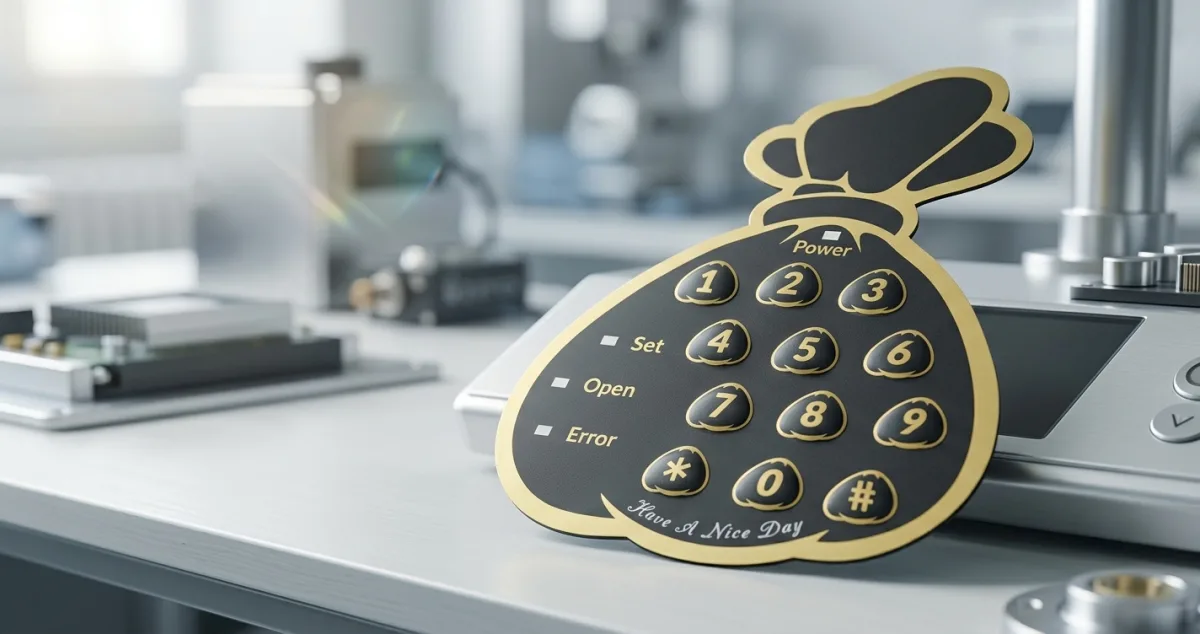
A graphic overlay (also known as a control panel overlay or faceplate) is a printed, durable plastic film attached to the outer surface of an electronic device, control panel, or membrane switch interface.
The graphic overlay is the upper, screen-printed layer of the membrane keypad. Such overlays can be made of polycarbonate or polyester with a matt or glossy appearance, depending on the needs of the customer. The membrane switch’s graphic overlay and decals, which identify the locations of switches, windows, LEDs, and printing materials with the Instruments brand and name, are an essential component. Graphic pictures are produced by screen-printing coloured inks on plain material. This layer becomes the graphic overlay after printing and cutting to size and shape.
Control panel overlays, front panels, graphic overlays and decals printed digitally provide the best printing quality and creative freedom without the constraints of other printing procedures. The layout and colour scheme are what make the end product resemble the client’s concept as per the methods we practice at Keetronics ( India ) Pvt. Ltd.
Our graphic overlay manufacturing services assist businesses in producing high-quality overlays and decals that can survive difficult situations. An overlay is often the first thing a person sees when interacting with a product and is frequently utilised as the crucial layer of a user interface. These parts must be simple to use and constructed of high-quality materials to ensure their endurance.
Our design engineers can employ a variety of finishing methods and materials for touchscreen interfaces, control panels, UV resistance, anti-glare, human-machine interfaces (HMI), and other application requirements. For a wide range of industries, including appliances, medical equipment, consumer electronics, etc., we have produced graphic overlays and decals. At Memtron, we can design overlays that can be used as membrane switch assemblies or as standalone labels.
Key Functions
-
User Guidance: Displays printed text, symbols, push-button outlines, and color coding to instruct users on how to operate the controls.
-
Environmental Protection: Serves as a sealed barrier that shields delicate internal electronics, circuits, and switches against moisture, dust, chemical spills, oils, and physical wear.
-
Branding: Feature company logos, product names, and customized design aesthetics to match corporate branding.
Common Materials
-
Polyester (PET): Highly durable, flexible, and resistant to chemicals and solvents. Preferred for interfaces with high-cycle mechanical key pressing (e.g., tactile membrane switches).
-
Polycarbonate (Lexan): Highly impact-resistant, easy to print on, and visually clear. Ideal for rigid control panels, though less chemical-resistant than polyester.
Key Features & Design Options
-
Subsurface Printing: Graphics and inks are printed on the reverse (back) side of the transparent plastic layer. This keeps the ink fully protected from scratching, UV exposure, and surface abrasion.
-
Embossing: Raised areas or rims over buttons (pill embossing or frame embossing) to provide tactile feedback when pressed.
-
Display Windows: Clear or tinted transparent sections for LCD/LED screens or indicators to shine through.
The manufacturing process of graphic overlays involves several precise steps to ensure high durability, accurate display, and proper fit for control panels and electronic devices:
-
Design and Artwork Preparation
-
Digital artwork (vectors) is generated using CAD or graphics software, establishing exact dimensions, color specifications (Pantone matching), display window locations, button placements, and key cutouts.
-
-
Material Selection & Preparation
-
Substrate materials—most commonly Polyester (PET) for high flex-life or Polycarbonate (Lexan) for impact resistance—are selected and cut into working sheets.
-
-
Subsurface Printing
-
Inks are reverse-printed onto the back (underside) of the transparent film so that the top plastic layer shields the graphics from scratches, solvents, and UV exposure.
-
Screen Printing is used for vibrant, high-opacity solid colors, metallic inks, and selective window coatings.
-
Digital Printing is used for complex gradients, photographic images, and short prototyping runs.
-
-
Applying Windows and Selective Coatings
-
Clear or tinted transparent inks are applied over display windows (for LCD/LED screens).
-
Anti-glare, scratch-resistant, or textured matte/gloss coatings are selectively applied to the front surface to improve readability and feel.
-
-
Embossing (Tactile Response)
-
Custom steel or aluminum male/female dies press the film to create raised surfaces over buttons (pill or frame embossing). This gives operators physical, tactile feedback when pressing keypads.
-
-
Adhesive Lamination
-
A high-performance pressure-sensitive adhesive transfer tape (such as 3M adhesive) is laminated to the printed back side.
-
Selective cutout areas are left un-adhered around display windows, LED paths, or internal mechanical components.
-
-
Precision Die Cutting
-
Steel rule dies, laser cutting, or CNC plotting are used to cut the outer shape of the overlay, internal display windows, mounting holes, and edge profiles to tight tolerances.
-
-
Quality Inspection & Packaging
-
Overlays undergo strict quality control, including color matching checks, dimensional checks, alignment inspection, and adhesive adhesion tests before final packaging.
-
Partnering with custom graphic overlay manufacturers offers several operational, technical, and commercial advantages:
-
Tailored Material & Finish Selection: Manufacturers help select exact substrates—such as chemical-resistant polyester (PET) or high-impact polycarbonate (Lexan)—along with specialized surface textures (matte, gloss, anti-glare, or scratch-resistant coatings) tailored to specific application environments.
-
Superior Durability & Longevity: Through subsurface reverse printing, manufacturers ensure that graphics, logos, and indicators remain fully protected from chemical exposure, UV rays, moisture, surface abrasion, and heavy daily use.
-
Enhanced Tactile & Ergonomic Design: Manufacturers incorporate custom embossing options (pill or frame embossing) that align with mechanical dome switches or keypads, providing clear tactile feedback for operators and improving user experience.
-
Precision Fitting & Tight Tolerances: Using laser cutting, CNC plotting, or steel rule dies, manufacturers create custom-shaped overlays with exact cutouts for display windows, LED status lights, connector pins, and mounting holes.
-
Custom Adhesive Integration: They apply high-performance pressure-sensitive adhesives (such as 3M transfer tapes) with custom cutout patterns, ensuring strong bonding to specific panel materials (metals, plastics, or powder-coated surfaces) without interfering with display windows or buttons.
-
Consistent Branding & Visual Appeal: Advanced color-matching systems (Pantone matching) and dual printing options (screen printing for rich solids, digital printing for photographic gradients) deliver professional, brand-accurate finishes.
-
Cost Efficiency & Scalability: Manufacturers accommodate both low-volume rapid prototyping for design testing and high-volume production runs that lower per-unit manufacturing costs.
Keetronics (India) Pvt. Ltd., an ISO 9001:2015 certified manufacturer based in Pune, India, specializes in custom graphic overlays, membrane keyboards, and Human-Machine Interface (HMI) products.
Need a custom HMI architecture for harsh operating conditions?
Talk to Our Team