
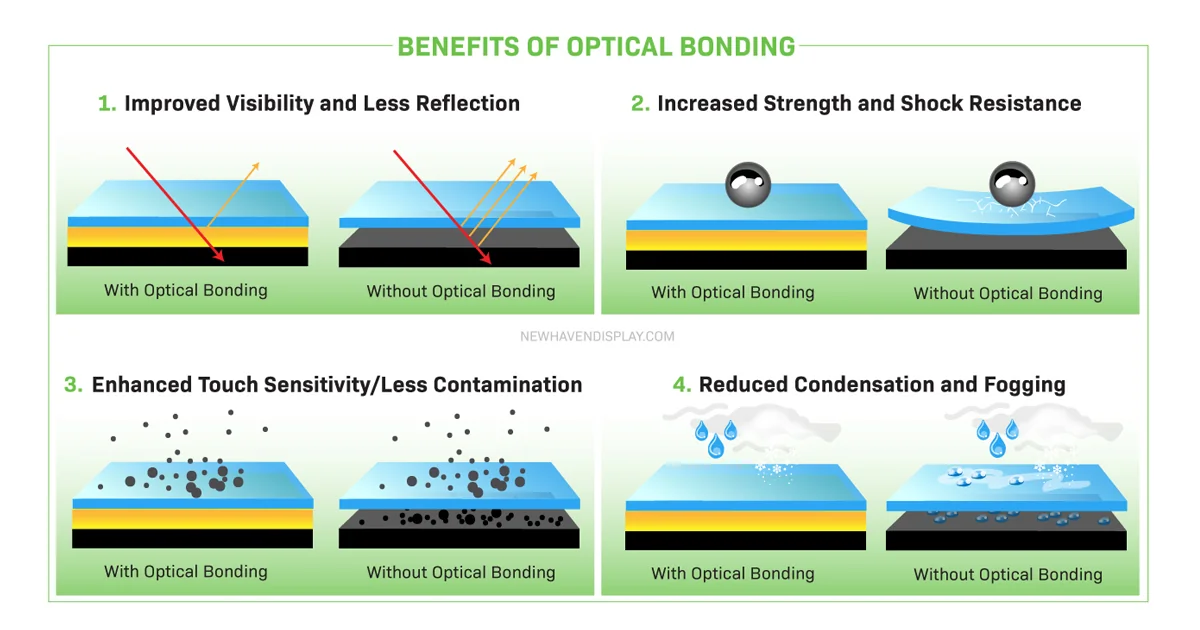
Optical bonding is the process of adhering a protective glass or touch panel directly to an LCD screen using a transparent liquid or film adhesive. By completely eliminating the internal air gap between the layers, it m...
Optical bonding is a manufacturing process used to glue a protective glass cover or a touch sensor panel directly onto an LCD display.
In standard displays, there is a small air gap between the outer glass and the underlying screen. Optical bonding completely fills this gap using a transparent adhesive, turning the display layers into a solid, seamless sandwich.
Key Benefits of Optical Bonding
-
Drastically Improved Sunlight Readability: In a standard screen, light reflects off both the outer glass and the inner display, causing severe glare. Eliminating the air gap reduces internal reflections by up to 400%, making the screen incredibly clear even under direct sunlight.
-
Enhanced Durability & Shock Resistance: Because the layers are fused into a single solid piece, the screen becomes much more resistant to physical impacts, scratches, and heavy vibrations.
-
No Internal Condensation or Dust: In humid or rapidly changing temperature environments, moisture can seep into a standard air-gap screen, causing it to fog up from the inside. Optical bonding makes it impossible for moisture or dust to get trapped.
-
Better Touch Accuracy (No Parallax Error): An air gap creates a visual separation between where your finger touches the glass and where the digital pixel actually is (called a parallax error). Removing the gap makes touch inputs feel much more precise and natural.
Common Methods Used
There are two primary ways manufacturers achieve this bond:
-
Wet Bonding (Optically Clear Resin - OCR): A liquid silicone or polyurethane resin is poured onto the display, the cover glass is pressed down, and the liquid is cured using UV light. This is highly durable and excellent for large or curved screens.
-
Dry Bonding (Optically Clear Adhesive - OCA): A pre-manufactured, double-sided adhesive film is laminated between the glass and the screen using pressure and heat. This process is cleaner and faster, making it popular for smartphones and smaller consumer devices.
Optical bonding is widely used in industries where displays must perform flawlessly under harsh conditions—such as intense sunlight, high humidity, heavy vibrations, or rugged daily use.
1. Marine & Boating Displays
Marine environments are the ultimate test for screens due to blinding sunlight and constant moisture.
-
Applications: GPS navigation plotters, fishfinders, sonar screens, and digital dashboard gauges.
-
Why it’s used: It prevents the screen from fogging up internally due to humidity and makes the display easily readable even with direct sunlight reflecting off the water.
2. Automotive & Transportation
Modern vehicles rely heavily on digital interfaces that must remain visible and intact during transit.
-
Applications: In-dash infotainment systems, digital instrument clusters, head-up displays (HUDs), and digital rearview mirrors.
-
Why it’s used: It minimizes distracting glare for the driver, increases impact safety (preventing glass from shattering into the cabin during a crash), and withstands constant vehicle vibrations.
3. Medical Devices
Medical equipment demands high visual precision and strict hygiene standards.
-
Applications: Operating room monitors, ultrasound machines, patient monitors, and handheld diagnostic tablets.
-
Why it’s used: It eliminates the parallax error (misalignment between where you touch and where the screen registers it), ensuring high touch accuracy. Additionally, sealing the air gap prevents cleaning fluids and biohazards from seeping into the display.
4. Military & Aerospace
Defense and aviation systems require "mission-critical" ruggedness where display failure is not an option.
-
Applications: Cockpit multi-function displays (MFDs), ruggedized field laptops/tablets, and tactical ground control stations.
-
Why it’s used: It allows displays to survive extreme temperature drops, high shock forces, and severe vibrations while remaining readable in bright desert or high-altitude environments.
5. Outdoor Kiosks & Digital Signage
Publicly accessible screens face weather elements and potential vandalism.
-
Applications: ATMs, gas pump screens, ticketing machines, digital billboards, and restaurant drive-thru menus.
-
Why it’s used: It significantly hardens the outer glass against vandalism and prevents dust, rain, and condensation from ruining the internal electronics.
6. Premium Consumer Electronics
As users expect sleeker, higher-performing devices, optical bonding has moved into everyday tech.
The optical bonding process requires extreme precision and is performed inside a dust-free cleanroom (usually Class 1000 or higher) to ensure no airborne particles get trapped between the layers.
Depending on the production volume and application, manufacturers use either a Wet Bonding (Liquid) or Dry Bonding (Film) process.
Method 1: The Wet Bonding Process (OCR / LOCA)
This method uses a liquid silicone, acrylic, or polyurethane resin. It is the preferred method for large displays, curved screens, or heavy-duty outdoor equipment.
[Clean & Prep Display] ➔ [Dispense Liquid Resin] ➔ [Vacuum/Press Assembly] ➔ [UV & Heat Cure]
-
Surface Preparation & Cleaning: Both the LCD panel and the cover glass are meticulously cleaned using specialized solvents and plasma treatment to remove microscopic dust, static electricity, and oils.
-
Dam & Fill (Dispensing): * A high-viscosity "dam" resin is bead-dispensed around the absolute perimeter of the display to act as a barrier.
-
A lower-viscosity "fill" resin is then dispensed in a precise pattern (like a "Z" or "V" shape) in the center of the display to ensure even spreading without bubbles.
-
-
Lamination & Vacuum Pressing: The cover glass is tilted and slowly lowered onto the liquid resin, often inside a vacuum chamber. The vacuum pulls out any trapped microscopic air bubbles while a machine applies uniform pressure to spread the liquid flat.
-
Curing: The assembled screen travels under a high-intensity UV (Ultraviolet) light fixture. The UV light triggers a chemical reaction that cures and hardens the liquid into a flexible, solid, gel-like layer. A secondary heat cure is sometimes used to dry areas shaded from the UV light.
Method 2: The Dry Bonding Process (OCA)
This method utilizes a pre-cut, solid, double-sided adhesive film. It is highly automated and heavily favored for high-volume consumer electronics like smartphones, smartwatches, and tablets.
-
Lamination to Glass: The Optically Clear Adhesive (OCA) tape is peeled from its protective backing and laminated directly onto the inner side of the cover glass or touch sensor using a roller machine.
-
Alignment & Vacuum Bonding: The glass (now with the sticky film attached) is mechanically aligned with the LCD panel. They are pressed together inside a vacuum chamber to prevent air pockets.
-
Autoclave Curing (Bubble Removal): Even with a vacuum, microscopic air bubbles can remain trapped in the film. The display is placed into an autoclave—a specialized chamber that applies high pressure (around 4 to 6 bars) and mild heat (about 40°C to 60°C). This forces any remaining air pockets to dissolve completely into the adhesive, leaving it crystal clear.
Comparison: Wet vs. Dry Processing
| Feature | Wet Bonding (OCR) | Dry Bonding (OCA) |
| Best Used For | Large screens, irregular shapes, rugged/outdoor use | Small screens, high-volume consumer electronics, flat surfaces |
| Reworkability | Easier (uncured or gel resin can be peeled or cleaned off if a defect is found) | Difficult (solid film bonds instantly; removing it often damages the LCD) |
| Thickness Control | Managed mechanically by dispensing volume and pressure | Absolutely uniform (pre-manufactured film thickness) |
| Gap Filling | Excellent for filling uneven steps or thick bezels | Limited to completely flat substrates |
-
Applications: Smartphones, smartwatches, high-end tablets, and rugged outdoor smart TVs.
-
Why it’s used: It allows for thinner device profiles, richer contrast with deeper blacks, and better battery life (since the backlight doesn't have to fight internal reflections).
Need a custom HMI architecture for harsh operating conditions?
Talk to Our Team