
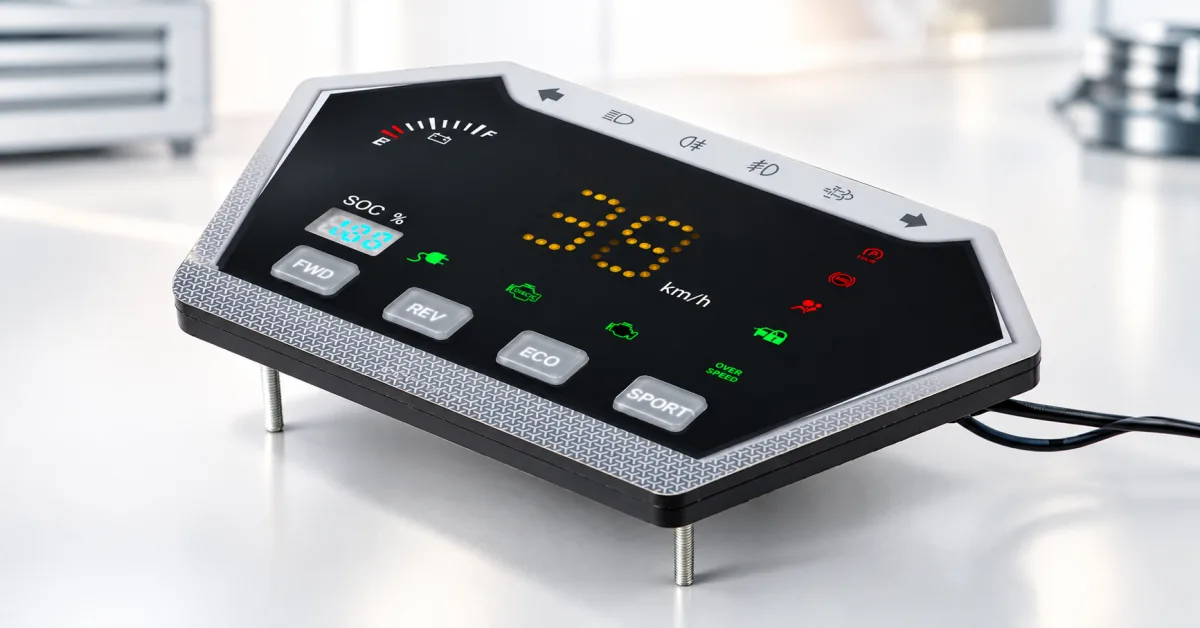
An automotive graphic overlay is a durable, printed plastic film applied over control panels, dashboard interfaces, or steering wheel buttons. It functions as a user interface layer that protects sensitive electronics f...
An automotive graphic overlay is a durable, custom-printed plastic film that acts as the outermost, user-facing layer of a vehicle's control panels. It is applied over dashboards, center consoles, steering wheel buttons, and instrument clusters to provide a protective, aesthetic, and functional interface for drivers and passengers.
Here is a breakdown of how they work, their key features, and why they are essential in modern vehicles:
How They Work & Key Features
· Reverse Printing (Second-Surface Printing): The graphics, icons, and text are printed on the underside of a clear protective film (typically made of high-quality polycarbonate or polyester). Because the ink is beneath the plastic layer, it is completely shielded from fingernail scratches, cleaning chemicals, and friction from constant use.
· Tactile Feedback (Embossing): Overlays can be designed with raised (embossed) areas. This allows drivers to physically feel where a button is (such as cruise control or volume) without having to take their eyes off the road.
· "Dead-Front" Lighting: This is a clever design technique where warning lights or icons (like the "Check Engine" or low fuel indicators) are completely invisible and blend into the background until they are illuminated from behind by an LED.
· Environmental Sealing: When combined with adhesive backings, these overlays create a tight seal. This protects the sensitive electronics underneath from moisture, dust, and spilled drinks.
ypical Applications in Vehicles
You interact with automotive graphic overlays every time you drive:
· Instrument Clusters: The gauge faces showing your speed, RPMs, and indicator lights.
· Climate & Audio Controls: The button interfaces on your center console.
· Steering Wheel Keypads: The integrated buttons used to navigate menus or adjust cruise control.
· Door Modules: The window-up/down controls and mirror adjustments.
Why Manufacturers Use Them
· Longevity: They are highly resistant to UV rays, extreme temperatures, and general wear and tear, ensuring the cabin controls look new for years.
· Cost-Effective Customization: Instead of redesigning underlying electronic circuits, manufacturers can change a vehicle's branding, language, or interior styling simply by changing the printed overlay.
The manufacturing process for an automotive graphic overlay is a highly precise, multi-step engineering method. Because these overlays must withstand harsh cabin environments (UV exposure, temperature swings, and chemical cleaners) while remaining visually pristine, the process requires specialized materials and printing techniques.
Here is the step-by-step manufacturing process:
1. Material Selection & Preparation
The process begins by choosing a high-performance, optically clear plastic substrate—typically polycarbonate (known for its impact resistance and clarity) or polyester (chosen for its superior chemical resistance and flex life over millions of button presses).
· The material thickness generally ranges from 5 to 20 mils (0.125mm to 0.5mm).
· Textures or coatings (like anti-glare, anti-scratch, or anti-microbial treatments) are applied to what will become the front-facing surface.
2. Design & "Second-Surface" (Reverse) Printing
Unlike standard labels where ink is printed on top, automotive overlays use second-surface printing.
· Graphics, text, branding, and borders are printed in reverse on the underside of the clear film.
· Screen printing or high-resolution digital printing is used to apply specialized, UV-curable inks layer by layer.
· Because the ink is beneath the plastic layer, the driver looks through the material at the graphics. This ensures the text and colors can never be scratched off by fingernails or worn away by friction.
3. Creating Selective Windows & "Dead-Fronts"
During the printing phase, specific areas are left unprinted or treated with translucent inks:
· Display Windows: Clear, unprinted zones are left open so digital LCD/OLED screens can shine through perfectly.
· Dead-Fronting: A specialized semi-opaque ink is applied over warning icons (like the "Check Engine" or "Low Fuel" lights). When the car is off, the dashboard looks completely blank and seamless. The icon only becomes visible when an internal LED light source behind it illuminates the panel.
4. Adhesive Application
A high-bond, die-cut adhesive layer (frequently from specialized lines like 3M) is laminated to the printed backside of the overlay.
· Manufacturers use selective texturing/die-cutting on the adhesive so that it avoids covering active display windows or areas where mechanical buttons need to move freely.
5. Embossing (Tactile Feedback)
To help drivers operate controls without looking away from the road, the overlay is placed into an embossing press.
· Using heat and a custom mold, specific button areas are raised or formed into shapes (like domes or rims).
· This provides physical, tactile boundaries that a driver can feel with their fingertips.
6. Die-Cutting & Finishing
The final sheet containing multiple overlays is moved to a cutting station.
· Precision Die-Cutting or Laser Cutting trims the perimeter of the overlay to its exact final dimensions.
· It also punches out any necessary through-holes for physical knobs, dials, or turn-signal stalks.
7. Inspection & Quality Control
Before shipping, overlays undergo rigorous quality checks to ensure they meet strict automotive standards:
· Backlit Testing: Verifying that light diffusion is even and "dead-front" icons don't bleed light.
· Dimensional Inspection: Making sure the cutouts align perfectly with the vehicle's underlying electronic sub-assemblies.
Keetronics (India) Pvt. Ltd. is a pioneering Indian manufacturing company specializing in advanced electronics, custom Human-Machine Interface (HMI) solutions, and input devices. Established in 1994, the company has over 32 years of industry experience and has completed more than 7,000 projects globally.
Keetronics designs, develops, and manufactures high-quality custom interfaces and automation hardware, including:
- Industrial Input Devices: PCB & PCF membrane switches, rugged customized computer keyboards, and metallic industrial keyboards.
- HMI & Displays: Customized rugged industrial touch displays and HMI solutions tailored for harsh environments.
- Smart Automation: Smart touch switches for homes, offices, and hotels, alongside custom embedded solutions.
- Specialized Industries: High-reliability input devices engineered specifically for defense, military, aerospace, medical, and marine applications.
Keetronics designs, develops, and manufactures high-quality automotive graphic overlay
Need a custom HMI architecture for harsh operating conditions?
Talk to Our Team