
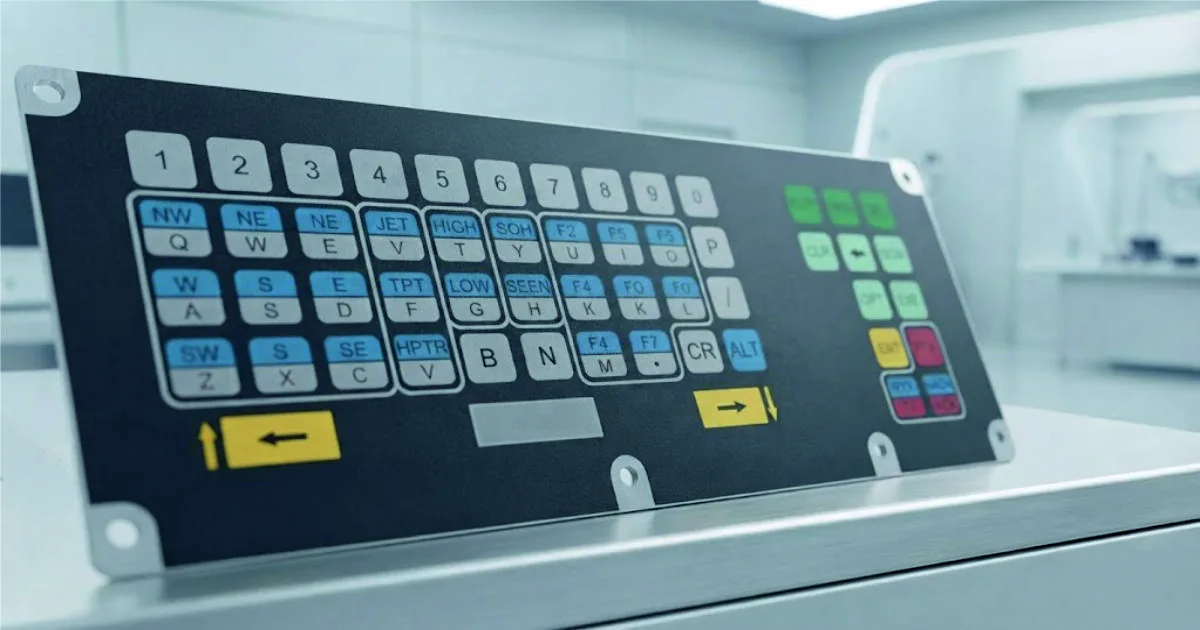
A leak testing Special Purpose Machine (SPM) operator keypad interfaces with the machine’s PLC. It allows operators to input testing parameters, start/stop test cycles, and monitor pressure decay or mass flow data. The....
A Leak Testing SPM (Special Purpose Machine) Operator Keypad is a specialized physical interface (or Human-Machine Interface - HMI) that allows a machine operator to control, configure, and monitor a custom-built leak testing machine.
These keypads connect directly to the machine's internal PLC (Programmable Logic Controller) to manage the entire testing sequence.
Key Functions of the Operator Keypad
1. Parameter Configuration
Before running a test, the operator uses the keypad to input precise testing variables, such as:
-
Target Test Pressure: The exact air or gas pressure required to test the component.
-
Stabilization Time: The duration allowed for the pressure inside the part to settle before measurement begins.
-
Test Time: The actual duration over which the system monitors for pressure drops or mass flow.
-
Reject Limits: The maximum allowable pressure decay or leak rate before a part is flagged as a failure.
Key Functions of the Operator Keypad
1. Parameter Configuration
Before running a test, the operator uses the keypad to input precise testing variables, such as:
-
Target Test Pressure: The exact air or gas pressure required to test the component.
-
Stabilization Time: The duration allowed for the pressure inside the part to settle before measurement begins.
-
Test Time: The actual duration over which the system monitors for pressure drops or mass flow.
-
Reject Limits: The maximum allowable pressure decay or leak rate before a part is flagged as a failure.
2. Mode Selection
Most SPM keypads allow operators to quickly toggle between operating states:
-
Manual Mode: Used by maintenance or setup technicians to manually "jog" individual cylinders, actuate clamping fixtures, or trigger specific valves.
-
Auto Mode: The standard production mode where the machine automatically clamps, seals, pressurizes, and tests parts in a continuous cycle.
3. Cycle Control & Monitoring
-
Start/Stop Buttons: Physical or membrane keys to safely initiate or abort a testing cycle once a part is loaded into the fixture.
-
Live Feedback: The keypad displays real-time pressure levels, elapsed cycle times, and current leak rates.
4. Status and Defect Indication
The keypad is equipped with clear visual indicators (often LEDs or a small digital display screen) to show the test results:
-
Pass / Accept: Indicates the component has successfully held pressure within the allowable limits.
-
Fail / Reject: Indicates a leak was detected, prompting the operator to set the defective part aside.
The manufacturing and development process of a Leak Testing SPM Operator Keypad involves a combination of industrial product design, electronics engineering, and rugged material fabrication to ensure it can survive harsh factory floors.
The step-by-step manufacturing process breaks down as follows:
1. Design & Engineering Phase
-
Electrical & Hardware Design: Engineers design the internal circuit board (PCB) that routes the physical key presses to the microcontroller. They define the communication protocol (like Modbus, CAN bus, or RS-485) required to interface seamlessly with the machine's central Programmable Logic Controller (PLC).
-
UI/UX & Graphic Layout: The visual interface is laid out. This includes mapping out where numerical keys, functional keys (Start, Stop, Calibrate, Menu), and status indicator LEDs (Pass/Fail) will sit.
-
Mechanical Enclosure Design: A 3D CAD model is created for the outer shell. Since these are used in industrial settings, engineers design the housing to achieve an IP65 or IP67 rating to guarantee dust and water resistance.
2. Component Manufacturing
-
The Overlay / Keypad Panel: Most industrial keypads use a silicone rubber panel or a polyester membrane overlay.
-
For silicone keypads (like those made by Keetronics), raw silicone is compression-molded into shape with built-in tactile conductive pills underneath.
-
The surface is then screen-printed or laser-etched with the legends (numbers, symbols) and coated with a protective PU layer to prevent chemical or oil wear.
-
-
PCB Assembly (PCBA): Surface Mount Technology (SMT) machines position and solder electronic components, resistors, LEDs, and communication chips onto the custom printed circuit board.
-
Enclosure Fabrication: The rugged outer shell—typically made from highly durable engineering plastics like PBT (Polybutylene terephthalate) or die-cast aluminum—is manufactured using injection molding or CNC machining.
3. Assembly Process
-
Integrating the Switch Layer: The printed membrane or silicone rubber keyboard is precisely aligned and bonded to the underlying PCB structure using industrial-grade acrylic adhesives.
-
Mounting the Display/LEDs: If the unit has a small built-in text or character display, it is attached and wired to the PCB.
-
Enclosure Sealing: The assembled PCB and keypad unit are fixed inside the shell. High-quality rubber gaskets or liquid sealing adhesives are applied along the seams to lock out moisture, oils, and environmental dust.
4. Testing & Quality Control
Before leaving the factory, the keypad must pass a battery of rigorous tests:
-
Functional Testing: Every button is pressed automatedly to check for electrical continuity and tactile bounce response.
-
Environmental/Thermal Cycling: The device is operated in extreme temperature chambers (often testing its reliability between 0°C and 50°C) to make sure components won't crack or fail under standard shop-floor conditions.
-
Ingress Protection (IP) Verification: The unit is tested against dust and water sprays to certify its sealing capabilities.
Keetronics (India) Pvt. Ltd. is a pioneering Indian manufacturing company specializing in advanced electronics, custom Human-Machine Interface (HMI) solutions, and input devices. Established in 1994, the company has over 32 years of industry experience and has completed more than 7,000 projects globally.
Keetronics designs, develops, and manufactures high-quality custom interfaces and automation hardware, including:
- Industrial Input Devices: PCB & PCF membrane switches, rugged customized computer keyboards, and metallic industrial keyboards.
- HMI & Displays: Customized rugged industrial touch displays and HMI solutions tailored for harsh environments.
- Smart Automation: Smart touch switches for homes, offices, and hotels, alongside custom embedded solutions.
- Specialized Industries: High-reliability input devices engineered specifically for defense, military, aerospace, medical, and marine applications.
Keetronics designs, develops, and manufactures high-quality Leak Testing SPM (Special Purpose Machine) Operator Keypad
Need a custom HMI architecture for harsh operating conditions?
Talk to Our Team